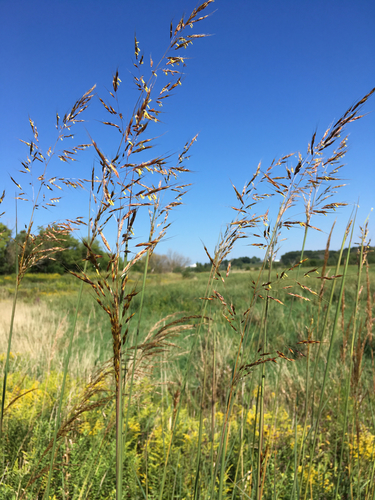
Indiangrass
Sorghastrum nutans
A golden giant of the North American prairie, Indiangrass provides striking vertical beauty and essential sanctuary for backyard wildlife. Its shimmering bronze plumes and sturdy stalks make it both a visual centerpiece and a bustling hub for birds and pollinators.
Quick Identification
Size
3 to 8 feet (0.9 to 2.4 meters) tall with a spread of 2 to 3 feet (0.6 to 0.9 meters)
Colors
Blue-green to gray-green foliage; golden-yellow to bronze-brown seed heads with prominent yellow anthers
Key Features
- Tall, upright bunchgrass growth habit
- Unique 'rifle-sight' ligule at the junction of leaf and stem
- Feathery, plume-like seed heads in shimmering gold and bronze
- Blue-green summer foliage that turns a rich orange-yellow in autumn
When You’ll See Them
Behavior
Indiangrass is a cornerstone species of the North American tallgrass prairie, celebrated for its deep root system and ability to provide structural integrity to any ecosystem. As a warm-season perennial, it remains relatively low to the ground in the spring, focusing its energy on root development before shooting upward during the heat of mid-summer. This growth cycle makes it an essential sanctuary for ground-nesting birds and small mammals looking for cool shade during the hottest months.
Unlike many ornamental grasses, Indiangrass is highly resilient to fire and drought, often becoming more dominant in landscapes that undergo periodic natural disturbances. It grows in distinctive bunches rather than spreading via aggressive runners, which allows it to coexist beautifully with native wildflowers. In the late summer and fall, its stiff, upright stems dance in the wind, releasing clouds of pollen and eventually heavy seeds that serve as a vital high-protein food source for migrating birds.
EverydayEarth exclusive
Camera Tips
To capture the true majesty of Indiangrass on your backyard camera, placement is everything. Position your camera at a low height—about 12 to 18 inches from the ground—and angle it slightly upward. This perspective emphasizes the grass's towering height and allows you to capture the silhouette of the golden seed heads against the sky. This angle is also perfect for catching the ground-level movement of rabbits, voles, and ground-feeding birds like Dark-eyed Juncos that frequent the base of the plant for cover and fallen seeds.
Lighting plays a massive role in how this species appears on digital sensors. Because of the metallic, bronze-gold sheen of the seed plumes, try to orient your camera facing West or East. This allows the rising or setting sun to backlight the grass, creating a 'halo' effect that makes the plumes glow on video. If you are using a camera with motion detection, be aware that tall grasses can cause frequent false triggers on windy days. To mitigate this, look for cameras with 'AI Animal Detection' filters or set your trigger sensitivity to a medium level so that only larger movements from visiting wildlife activate the recording.
The late fall and winter months are actually the best time for wildlife observation around Indiangrass. Because the stalks are sturdy and 'standing,' they remain upright even under light snow, providing a natural perch for foraging songbirds. You don't need to use artificial lures; the seed heads themselves are the bait. Frame your shot to include the top third of the grass where sparrows and finches are likely to land. If you want to see the insects that call this grass home, use a camera with a macro or close-focus capability and aim it at the 'rifle-sight' ligule area of the stem where many small insects seek shelter.
Similar Species
Species that look similar or are commonly confused with Indiangrass.
Big Bluestem
Big Bluestem features a three-pronged seed head resembling a turkey's foot, whereas Indiangrass has a single, feathery plume.
Switchgrass
Switchgrass has a much more open, airy, and mist-like seed head compared to the dense, golden plumes of Indiangrass.
Little Bluestem
Little Bluestem is much shorter (2-4 feet) and develops a striking reddish-blue color in the fall with fuzzy white seed heads.
Frequently Asked Questions
Record Indiangrass at your habitat
Connect a camera to start building your own species record — AI identifies every visitor automatically.