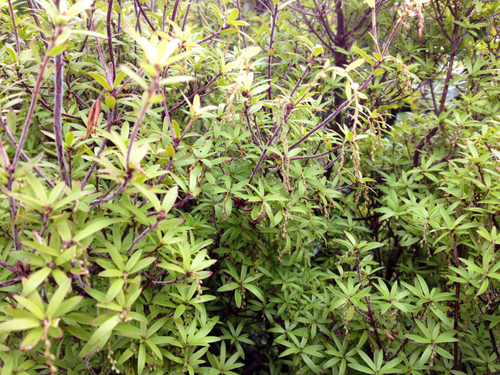
Tall Mingimingi
Leucopogon fasciculatus
A hardy New Zealand native, the Tall Mingimingi is a cornerstone of the forest understory, known for its delicate bell-shaped flowers and vibrant berries that feed a wealth of native birds.
Quick Identification
Size
2–5 metres (6.5–16 feet) in height; leaves 10–25mm (0.4–1 inch) long
Colors
Dark green foliage with pale undersides; creamy-white or greenish flowers; red, pink, or orange berries
Key Features
- Erect shrub or small tree up to 5m tall
- Small, bell-shaped flowers in drooping clusters (fascicles)
- Narrow, lance-shaped leaves with 3-5 parallel veins
- Fleshy berries ranging from bright red to orange
When You’ll See Them
Geographic range
Where Does the Tall Mingimingi Live?
The Tall Mingimingi is a proud endemic of New Zealand, found naturally nowhere else on Earth. Its primary stronghold is the North Island, specifically in regions north of the Bay of Plenty and Taranaki. In the South Island, its distribution is more localized, primarily appearing in the rugged landscapes of North West Nelson. It thrives in diverse environments, from sea-level coastal scrub to the cool, damp understory of silver and red beech forests.
Basemap © OpenStreetMap contributors
Behavior
Tall Mingimingi is a foundational species in New Zealand's regenerating forests. While it may appear as a modest shrub, it plays a vital role in the ecosystem by providing a steady supply of nectar and fruit. During its flowering season from spring to early summer, the shrub produces delicate, honey-scented blossoms that attract a variety of native pollinators, including bees and butterflies.
As a long-lived perennial, it is remarkably hardy, often acting as a 'nurse plant' that shelters smaller seedlings from harsh winds and sun. For humans, it is a familiar sight along bush tracks, often recognized by its slightly prickly texture and the vibrant splash of color provided by its berries in the autumn months. It does not move, of course, but its branches are frequently alive with the movement of birds seeking its fruit.
EverydayEarth exclusive
Camera Tips
When targeting Tall Mingimingi with an AI-powered camera, your goal isn't just to capture the plant, but the wildlife it hosts. Position your camera approximately 1.5 to 2 metres high, angled slightly downward toward a branch heavy with flowers or berries. Because this shrub is a favorite of nectar-feeders like Tui and Bellbirds (Korimako), focusing on a specific cluster of blooms will yield the best results.
For the best lighting, aim for a spot that receives dappled morning sun. The white flowers can easily 'blow out' and lose detail in harsh midday light, so early morning or late afternoon settings are ideal. If your camera allows for macro or close-focus settings, use them to capture the intricate, hair-like textures inside the tiny bell flowers, which are a hallmark of the Leucopogon genus.
During the fruiting season (late summer to autumn), the red and orange berries become the main attraction. Place your camera near a sturdy branch that provides a good 'landing pad' for birds. You won't need bait, as the berries themselves act as a natural lure. Ensure your trigger speed is set to its fastest setting, as birds darting in for a quick snack move incredibly quickly. Check your lens regularly for spider webs, as the dense structure of Mingimingi is a favorite site for local orb-weavers.
Similar Species
Species that look similar or are commonly confused with Tall Mingimingi.
Frequently Asked Questions
Record Tall Mingimingi at your habitat
Connect a camera to start building your own species record — AI identifies every visitor automatically.