Prickly mingimingi
Leptecophylla juniperina
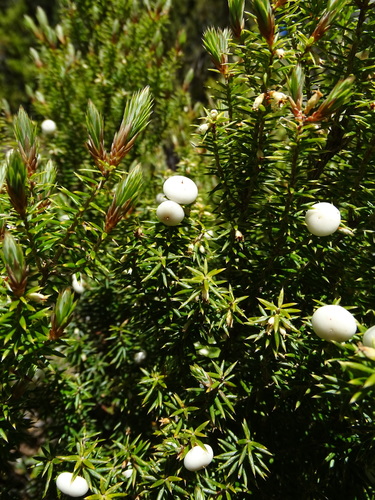
A resilient, berry-bearing shrub that provides a prickly sanctuary for Oceania's native birds. Its vibrant pink and white drupes are a highlight of the temperate forest floor and coastal scrub.
Quick Identification
Size
Typically 1-2 metres (3.3-6.6 feet) in height, though it can grow up to 4 metres (13 feet) in sheltered forest conditions.
Colors
Dark olive-green foliage with silvery-white leaf undersides; berries range from waxy white and pale pink to deep crimson red.
Key Features
- Narrow, needle-like leaves with sharp, prickly tips
- Small, creamy-white bell-shaped flowers
- Fleshy, marble-like drupes (berries) in white or pink
- Fine, woody branching structure with dark brown bark
When You’ll See Them
Geographic range
Where Does the Prickly mingimingi Live?
Native to the southern regions of Oceania, the Prickly mingimingi is a resilient resident of both New Zealand and southeastern Australia. In New Zealand, it is widespread from the North Island through to the South Island and Stewart Island, even reaching the sub-antarctic Auckland Islands. Across the Tasman Sea, it maintains a strong presence in Tasmania, Victoria, and New South Wales, primarily inhabiting coastal fringes and cool-temperate montane environments.
Basemap © OpenStreetMap contributors
Behavior
Prickly mingimingi is a hardy, slow-growing evergreen shrub that serves as a vital structural component of its ecosystem. While it remains stationary, its 'behavior' is defined by its seasonal transformation and its role as a nursery for local fauna. Its dense, prickly foliage provides a fortress-like protection for small birds and insects, shielding them from larger predators and harsh winds.
Ecologically, the plant is a generous host. In the spring, it produces a profusion of tiny, honey-scented flowers that draw in pollinators. By late summer, these flowers develop into long-lasting, colorful berries. These berries are a preferred food source for various native birds, which in turn assist the plant by dispersing its seeds across the landscape, ensuring its survival in new territories.
EverydayEarth exclusive
Camera Tips
When using an AI-powered camera to capture the Prickly mingimingi, your goal is to document the wildlife it attracts. Position your camera on a sturdy tripod or mount it to a nearby post approximately 1 to 1.5 metres from the shrub. Focus your lens on a cluster of ripening berries, as this is where the most 'action' will occur. Because the leaves are small and needle-like, use a camera with a high-resolution sensor to ensure the AI can distinguish between the plant's prickly texture and a visiting bird or insect.
Lighting is key for this species. The waxy surface of the pink and white berries can reflect bright sunlight, causing 'hot spots' in your images. Set your camera to trigger during the golden hours—early morning or late afternoon—to capture the most vibrant colors without harsh glare. If your camera allows for sensitivity adjustments, set it to high; the movement of a tiny Silvereye or Fantail darting through the sharp leaves can be very quick and subtle.
During the autumn months, the shrub is at its most photogenic. If you are placing a camera in a backyard setting, consider a low-angle shot looking up into the branches. This perspective often captures the underside of the leaves, which have beautiful silver striations, and makes the colorful berries pop against the sky. Be mindful of wind; the stiff, prickly branches can sway and cause false triggers. Use your camera's masking tool to ignore the outer, thinner branches and focus the trigger zone on the more stable, berry-laden inner stems.
Similar Species
Species that look similar or are commonly confused with Prickly mingimingi.
Frequently Asked Questions
Record Prickly mingimingi at your habitat
Connect a camera to start building your own species record — AI identifies every visitor automatically.