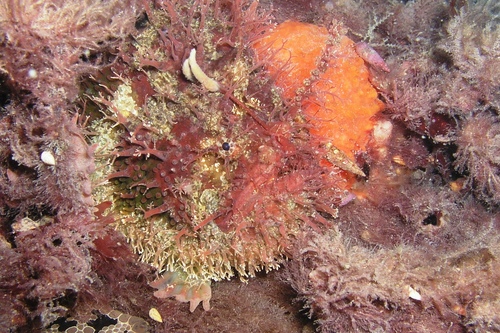
Tasselled Anglerfish
Rhycherus filamentosus
The ultimate master of disguise, the Tasselled Anglerfish 'walks' along the Australian seafloor using its fins like legs. With a body covered in leafy filaments and a built-in fishing lure, it is one of the most fascinating predators you can find in coastal reefs.
Quick Identification
Size
Typically 15-23 cm (6-9 inches) in length
Colors
Highly variable mottled patterns of tan, reddish-brown, orange, and white to mimic surrounding sponges and algae; no significant sexual dimorphism in color
Key Features
- Body covered in long, branched skin filaments or 'tassels'
- First dorsal spine modified into a lure (illicium) with a fleshy, worm-like tip (esca)
- Thick, limb-like pectoral and pelvic fins used for walking
- Stocky, compressed body with a large, upward-pointing mouth
When You’ll See Them
Geographic range
Where Does the Tasselled Anglerfish Live?
Native to the cool temperate waters of the Southern Hemisphere, the Tasselled Anglerfish is an endemic Australian treasure. It is primarily found along the southern coastline, with its core range stretching from the waters of New South Wales and Victoria, around the entirety of Tasmania, and westward to the southern reaches of Western Australia. These fish are most frequently encountered in sheltered bays and shallow reef systems where sponge growth is prolific.
Basemap © OpenStreetMap contributors
Behavior
The Tasselled Anglerfish is a master of patience and one of the most effective ambush predators in the ocean. Rather than swimming through the water column, it spends most of its time motionless on the seabed, perfectly blending into rocky reefs and sponge gardens. It uses its highly adapted pectoral and pelvic fins to 'walk' across the substrate with a slow, deliberate gait that avoids alerting potential prey or predators.
When hunting, the anglerfish employs a sophisticated biological fishing rod. It slowly waves its illicium (a modified dorsal spine) to dance the worm-like lure just above its mouth. When a curious fish or crustacean approaches the lure, the anglerfish expands its oral cavity with incredible speed, creating a vacuum that sucks the prey inside in as little as six milliseconds. This species is generally solitary and rarely interacts with humans unless encountered by divers, to whom they usually remain indifferent due to their reliance on camouflage.
EverydayEarth exclusive
Camera Tips
Capturing the Tasselled Anglerfish requires an underwater camera setup, such as a waterproof action camera or a specialized reef-cam housing. Because these fish are sedentary and prefer high-structure environments, the best placement for your camera is near the base of pier pylons or along the edges of rocky crevices at depths of 3 to 10 meters. Ensure the camera is weighted or mounted securely to prevent movement from tidal surges, which can trigger false motion alerts.
For the best results, position the camera at a 'fish-eye' level, roughly 10-15 centimeters above the seabed. This low-angle perspective captures the intricate 'walking' motion of their fins and the delicate movement of their tassels in the current. Since they rely on camouflage, use a high-resolution setting (4K if possible) to distinguish the fish from the surrounding sponges and algae; otherwise, they may simply look like a lump of reef on low-quality footage.
While you shouldn't bait the anglerfish directly, placing your camera near a natural congregation of small shrimp or baitfish will increase your chances of witnessing a strike. If your camera has a time-lapse mode, set it to take a photo every 30 seconds; because these fish move so slowly, a standard motion sensor may not always trigger. During the night, use a diffused red light filter to avoid startling the fish while still illuminating the incredible textures of its skin filaments.
Similar Species
Species that look similar or are commonly confused with Tasselled Anglerfish.
Frequently Asked Questions
Record Tasselled Anglerfish at your habitat
Connect a camera to start building your own species record — AI identifies every visitor automatically.