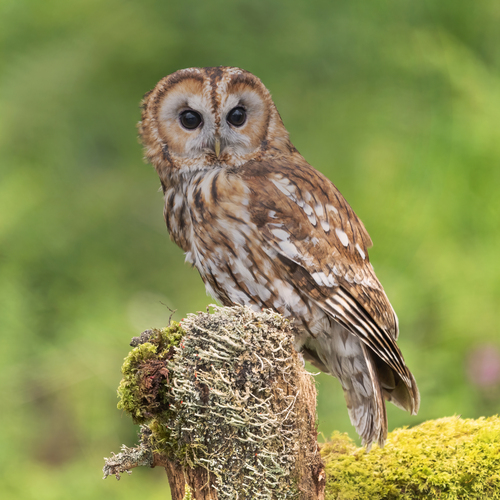
Tawny Owl
Strix aluco
The Tawny Owl is the master of the midnight forest, a silent hunter with a voice that defines the sounds of the night. With their dark, liquid eyes and incredible camouflage, they are the ultimate backyard mystery waiting to be discovered.
Quick Identification
Size
Length: 37–43 cm (14.5–17 in); Wingspan: 81–96 cm (32–38 in); Weight: 330–590 g (0.73–1.3 lbs)
Colors
Mottled brown or grey upperparts; pale underparts with heavy dark vertical streaks; dark brown eyes; no ear tufts
Key Features
- Large rounded head with no ear tufts
- Dark, soulful eyes (unlike most owls with yellow or orange)
- Stocky build with a relatively short tail
- Pale facial disk framed by a darker border
When You’ll See Them
Behavior
Tawny Owls are the quintessential nocturnal hunters, known for their incredible stealth and the iconic 'tu-whit tu-whoo' duet. They are sit-and-wait predators, often spending long periods motionless on a favored perch, scanning the ground for the slightest movement or sound. Despite their somewhat cuddly appearance, they are fiercely territorial and will defend their home range year-round, often using the same nesting site for many years.
These owls have adapted remarkably well to human presence, often living in suburban gardens and city parks as long as there are mature trees for roosting. While they are rarely seen during the day—relying on their bark-like plumage to camouflage against tree trunks—their presence is announced at night through a complex series of hoots and sharp 'kewick' calls. They are highly sedentary birds; once a young owl establishes a territory, it rarely moves more than a few kilometers from that spot for the rest of its life.
EverydayEarth exclusive
Camera Tips
To capture high-quality footage of a Tawny Owl, placement is everything. These owls love 'lookout' branches that provide a clear view of the ground. Look for horizontal, sturdy branches about 3 to 5 meters (10–16 feet) high that have a clear 'drop zone' beneath them. If you have a bird feeder that attracts mice or voles at night, try mounting your camera on a nearby tree facing the feeder or the ground beneath it, as owls will frequently use these areas as hunting grounds.
Because they are strictly nocturnal, your camera's infrared (IR) performance is critical. Use a camera with 'No-Glow' or 'Black Flash' LEDs. Standard IR LEDs emit a faint red glow that Tawny Owls, with their exceptional night vision, can easily detect. This might cause them to avoid the area or behave unnaturally. Set your camera to a high-sensitivity trigger mode and a short video burst (15-20 seconds) to capture their silent flight or the moment they pounce on prey.
During the spring (February through May), you can focus your efforts on nesting boxes. Tawny Owls readily use large, chimney-style nest boxes or natural hollows in old oak or beech trees. Mount your camera on a neighboring tree about 2-3 meters away from the entrance hole. Ensure the camera is angled slightly downward to avoid lens flare from the moon and to get a better view of the owl landing on the box edge. In the autumn, they are most vocal and active in defending territories, making it a great time to place cameras near thick ivy-covered trees where they might roost during the day.
Avoid using vocal lures or artificial bait, as this can disrupt their natural hunting patterns or cause unnecessary stress during the breeding season. Instead, focus on creating a 'wildlife-friendly' zone in your yard by leaving leaf piles or tall grass, which attracts the rodents that Tawny Owls naturally hunt. If you have a birdbath, keep it filled; Tawny Owls are known to visit water sources late at night for a drink or a quick bath, providing excellent and unexpected footage.
Similar Species
Species that look similar or are commonly confused with Tawny Owl.
Frequently Asked Questions
Record Tawny Owl at your habitat
Connect a camera to start building your own species record — AI identifies every visitor automatically.