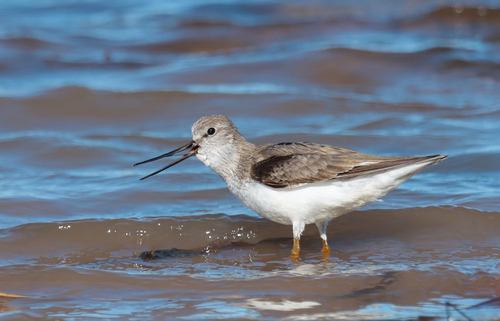
Terek Sandpiper
Xenus cinereus
Meet the Terek Sandpiper, a world-traveling shorebird known for its comical 'run-and-snatch' foraging style and its elegantly upturned bill. These vibrant waders bridge the gap between the Siberian tundra and tropical coastlines.
Quick Identification
Size
Length: 22-25 cm (8.7-9.8 in); Wingspan: 57-59 cm (22.4-23.2 in); Weight: 60-100 g (2.1-3.5 oz)
Colors
Pale grey-brown upperparts, white underparts, distinctive black bill with a yellow or orange base, and bright orange-yellow legs.
Key Features
- Long, strongly upturned black bill with a yellow base
- Bright orange or yellowish-orange legs
- Energetic, 'frantic' running and foraging style
- Distinctive dark 'V' shape on the back formed by scapular feathers
When You’ll See Them
Geographic range
Where Does the Terek Sandpiper Live?
Native to the Palearctic region, the Terek Sandpiper breeds across a vast belt from Finland and Northwest Russia through Siberia. As a long-distance migrant, it travels south to spend the winter along the tropical coasts of East Africa, Southern Asia, and Australia. While they are occasionally spotted as vagrants in Western Europe and North America, their core non-breeding range spans from the Red Sea and Persian Gulf down to the shores of the Indian Ocean.
Basemap © OpenStreetMap contributors
Behavior
The Terek Sandpiper is famously energetic, often described as having a 'frantic' personality compared to other waders. While many shorebirds stand still to probe the mud, the Terek is constantly on the move, sprinting across mudflats and making sudden, sharp turns to snatch prey from the surface. They are also known for a characteristic tail-bobbing motion, which becomes more pronounced when they are alert or nervous.
During the breeding season in the north, they can be quite vocal, but for most of the year, they are social birds that congregate in small flocks. They often associate with other species like Redshanks or Curlew Sandpipers. In their wintering grounds, they are tied strictly to the tidal cycle, foraging actively as the tide recedes and gathering in tight roosting groups on beaches or in mangroves during high tide.
EverydayEarth exclusive
Camera Tips
Capturing a Terek Sandpiper on camera requires understanding their relationship with the tides. If you have a backyard that borders a tidal creek or mudflat, place your camera just above the high-tide line. As the water rises, it pushes the birds toward the shore, bringing them within range of your lens. Using a low tripod or a ground mount (roughly 6-12 inches high) provides an intimate, eye-level perspective that highlights their unique upturned bill.
Because these birds are incredibly fast runners, shutter speed is your most important setting. If your camera allows for manual adjustments, aim for 1/1000th of a second or faster to freeze their 'scurrying' motion. If using a trigger-based trail camera, ensure the PIR sensitivity is set to 'High' to catch their small frames as they zip past the sensor. A burst mode of 3-5 photos per trigger is highly recommended to ensure at least one clear shot of their face.
While traditional bird feeders won't attract this species, you can lure them to a specific spot by identifying a 'roosting' point. These are typically flat rocks or patches of dry sand where shorebirds gather to rest during high tide. Look for areas with existing bird tracks or droppings. Positioning your camera near these spots during the hour of peak high tide is your best chance for a clear, still portrait rather than a motion-blurred action shot.
Similar Species
Species that look similar or are commonly confused with Terek Sandpiper.
Frequently Asked Questions
Record Terek Sandpiper at your habitat
Connect a camera to start building your own species record — AI identifies every visitor automatically.