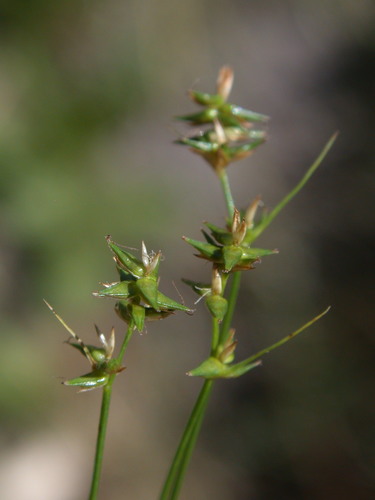
Texas sedge
Carex texensis
Texas Sedge is the unsung hero of the woodland garden, offering a soft, fine-textured carpet that thrives where grass refuses to grow. This resilient native plant provides essential habitat for backyard wildlife while maintaining a lush, green presence year-round.
Quick Identification
Size
Height: 15-30 cm (6-12 inches); Width: 15-30 cm (6-12 inches)
Colors
Bright green foliage; straw-colored to light brown seed heads (spikes) in late spring
Key Features
- Fine, hair-like foliage less than 2mm wide
- Distinctive star-shaped seed clusters (perigynia)
- Triangular stems typical of the Cyperaceae family
- Low-growing, clumping growth habit
When You’ll See Them
Geographic range
Where Does the Texas sedge Live?
Native to the North American continent, Texas Sedge is primarily found throughout the eastern and central United States. Its core range stretches from the grassy plains of Texas and Oklahoma eastward to the Atlantic coast and northward into the Ohio River Valley. While most abundant in the humid subtropical regions of the South, it has successfully established itself in diverse landscapes ranging from sandy coastal plains to upland deciduous forests.
Basemap © OpenStreetMap contributors
Behavior
Texas sedge is a perennial, cool-season plant that exhibits a graceful, arching growth habit. Unlike many turf grasses that spread via aggressive runners, this species grows in tidy, non-invasive clumps. It is particularly active during the spring and fall when temperatures are mild, often remaining semi-evergreen or fully evergreen in warmer southern climates. Its growth is modest but steady, eventually forming a soft, textured carpet if planted in groups.
As a member of the sedge family, it plays a vital role in local ecosystems by providing early-season cover for ground-nesting insects and small vertebrates. It does not 'behave' like a weed; instead, it colonizes dappled shade areas where traditional grasses struggle. While it can handle light foot traffic, it is primarily valued for its ornamental stability and its ability to stabilize soil in woodland garden settings without requiring the heavy fertilization or mowing associated with standard lawns.
EverydayEarth exclusive
Camera Tips
To capture the subtle beauty of Texas Sedge, position your camera at a low 'worm's-eye' view, approximately 6 to 10 inches off the ground. This perspective highlights the plant’s fine-textured foliage and the unique star-shaped seed heads that appear in late spring. Using a macro lens or a camera with a short focal distance is essential for showcasing the intricate details of the perigynia. Because this plant is a favorite hiding spot for small reptiles and insects, a low-angle setup increases your chances of spotting backyard safari action within the grass-like blades.
Lighting is crucial for plant photography; the best footage is often captured during the 'golden hours' of dawn and dusk when low-angle sunlight makes the bright green blades appear to glow. If your camera has a time-lapse feature, set it to trigger every 15–30 minutes during the early spring months. This allows you to document the green-up phase and the rapid emergence of flower spikes. Avoid using heavy baits near the sedge if you want to see natural behavior; instead, keep the area slightly moist to attract the small amphibians and insects that naturally congregate around its base.
For those interested in the wildlife that visits Texas Sedge, consider a trail camera with high-speed trigger sensors. Small mammals like voles or ground-feeding birds often forage for seeds among the clumps. Ensure your camera is secured to a small stake rather than a swaying branch to prevent false triggers from the wind blowing the thin leaves. Since Texas Sedge is evergreen in many southern zones, it provides a rare splash of color for your winter trail cam captures when the rest of the landscape is brown.
Similar Species
Species that look similar or are commonly confused with Texas sedge.
Frequently Asked Questions
Record Texas sedge at your habitat
Connect a camera to start building your own species record — AI identifies every visitor automatically.