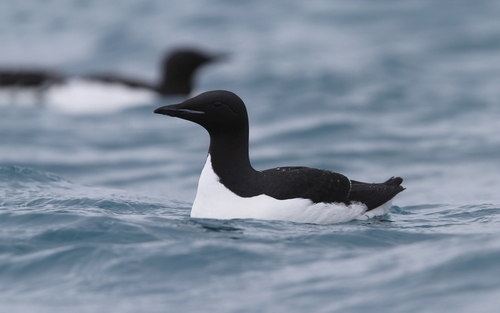
Thick-billed Murre
Uria lomvia
Rugged, resilient, and built for the deep, the Thick-billed Murre is the Arctic's answer to the penguin. These tuxedo-clad divers spend their lives braving the icy northern seas, returning to land only to perform gravity-defying nesting feats on the world's most precarious cliffs.
Quick Identification
Size
Length of 40-48 cm (16-19 in), wingspan of 64-81 cm (25-32 in), and weight between 730-1,480 g (1.6-3.3 lbs).
Colors
Solid black head, neck, and back with a sharp transition to a pure white belly. Adults in breeding season feature a distinctive white line along the cutting edge of the upper bill.
Key Features
- Sharp, pointed bill with a prominent white horizontal line at the base
- Deep charcoal-black upperparts contrasting sharply with white underparts
- Stocky, upright posture similar to a penguin when on land
- Pointed tail and short, rapid wingbeats in flight
When You’ll See Them
Behavior
The Thick-billed Murre is a master of the deep, often referred to as the 'penguin of the north.' Unlike penguins, however, these birds are strong fliers, though they require a running start over water to get airborne. They are highly social, nesting in massive, noisy colonies that can number in the hundreds of thousands. On the cliffs, they are packed tightly together, often standing shoulder-to-shoulder on narrow ledges where they lay a single, pear-shaped egg designed to spin in a circle rather than roll off the edge.
Foraging is where the Thick-billed Murre truly shines. They are pursuit-divers, using their wings like flippers to 'fly' underwater to depths exceeding 100 meters (330 feet) in search of prey. While they are generally wary of humans at sea, they can be remarkably tolerant at their nesting sites, allowing researchers and coastal observers to witness their complex social displays and vocalizations, which range from guttural growls to soft purring.
EverydayEarth exclusive
Camera Tips
Capturing the Thick-billed Murre on camera requires a strategic approach since they are rarely found in traditional 'backyards' unless you live on a rugged coastline. If you have a coastal property or access to a cliffside overlook, position your camera on a stable tripod or a secure rock mount facing the narrow ledges where birds congregate. Because of the high-contrast 'tuxedo' plumage, use a camera with a high dynamic range to avoid blowing out the white feathers in direct sunlight. A slightly underexposed setting is often safer than overexposing.
For those using trail cameras near colonies, timing is everything. The most dramatic footage occurs during 'the leap,' which usually happens in late July or August. This is when the three-week-old chicks, who cannot yet fly, jump from the high cliffs into the ocean to join their fathers. Set your camera to 'Burst Mode' or high-frame-rate video (60fps or higher) to capture this fast-moving action. Since these environments are often misty or sprayed with salt, a high-quality weather-sealed housing or a protective 'rain coat' for your camera is essential to prevent lens fogging and corrosion.
Because these birds are active throughout the long Arctic summer days, you can capture great footage at almost any hour. However, the 'golden hours' of early morning and late evening provide a softer light that highlights the subtle white line on their bill, which is their most defining feature. Avoid using flash, as it can startle nesting birds; instead, rely on the natural ambient light of the coastal environment. If you are setting up a remote camera, ensure it is anchored heavily, as cliffside winds can be powerful enough to knock over standard tripod setups.
Similar Species
Species that look similar or are commonly confused with Thick-billed Murre.
Common Murre
The Common Murre lacks the white line on the bill and generally has a more chocolate-brown hue to its dark feathers compared to the Thick-billed's deep black.
Razorbill
Razorbills have a much thicker, blunt, vertically-flattened bill with white circular markings, whereas the Thick-billed Murre's bill is pointed.
Frequently Asked Questions
Record Thick-billed Murre at your habitat
Connect a camera to start building your own species record — AI identifies every visitor automatically.