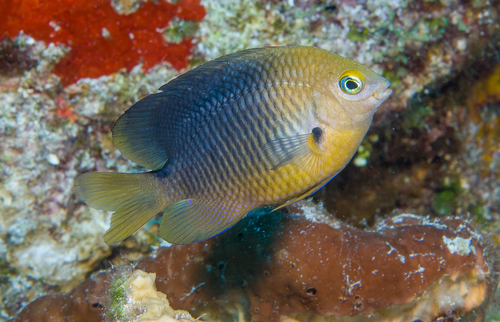
Threespot Damselfish
Stegastes planifrons
The feisty 'farmer' of the reef, the Threespot Damselfish is a tiny powerhouse that aggressively defends its underwater garden from all intruders.
Quick Identification
Size
Adults reach 10-13 cm (4-5 inches) in length; weight is typically under 100 grams (3.5 oz).
Colors
Juveniles are bright yellow with a black spot on the dorsal fin and tail. Adults are dark dusky-grey or olive-brown with a black spot at the pectoral fin base and a dark saddle on the tail base.
Key Features
- Black spot at the base of the pectoral fin
- Dark 'saddle' spot on the upper part of the tail base
- Deep, oval body with a steep head profile
- Aggressive charging behavior when defending territory
When You’ll See Them
Behavior
The Threespot Damselfish is one of the most spirited and territorial residents of the Western Atlantic reefs. Often described as 'reef farmers,' these fish create and maintain their own algal gardens. They meticulously weed out types of algae they find unpalatable, allowing their preferred food—fine, filamentous algae—to flourish in a concentrated patch. This behavior isn't just about food; it's a full-time job that requires constant patrolling and maintenance.
Their social structure is dominated by intense territoriality. Unlike many reef fish that flee when approached by humans or larger predators, the Threespot Damselfish is famous for its 'bravery.' They will aggressively charge at divers, snorkelers, and much larger fish that venture too close to their garden. While their tiny nips are harmless to humans, this bold attitude makes them a favorite for underwater photographers who want a subject that won't swim away.
EverydayEarth exclusive
Camera Tips
To capture the feisty personality of a Threespot Damselfish, you need to locate their 'garden'—a specific patch of reef or rock that looks slightly different or 'cleaner' than the surrounding area. Use an underwater action camera (like a GoPro) mounted on a weighted short tripod or a 'gorillapod' that can be wrapped around a dead coral branch. Positioning is key: place the camera about 12 inches away from their central algal patch, angled slightly upward to catch the fish against the light of the water surface. This perspective emphasizes their defensive 'charging' behavior.
Because these fish are highly territorial, you don't actually need bait. In fact, placing a foreign object (like the camera itself) near their territory will usually trigger an immediate response. The fish will likely swim right up to the lens to inspect or even nip at it. This provides incredible high-definition macro footage of their facial features and the distinctive black spot at the base of their pectoral fins. Ensure your camera is set to a high frame rate (60fps or higher) to capture their quick, darting movements smoothly.
For the best color saturation, shoot during the middle of a sunny day when light penetration is at its peak. Threespot Damselfish territories are usually in shallow water, so natural light is often sufficient to show off the subtle iridescent blue edges on their scales. If you are using an underwater housing, make sure the lens port is spotless, as the fish will likely get very close. If you want to see their 'farming' in action, try placing a small piece of loose seagrass or a tiny pebble in their garden; the fish will quickly dart in to pick up the 'trash' and carry it away, which makes for a perfect behavior-focused video clip.
Similar Species
Species that look similar or are commonly confused with Threespot Damselfish.
Frequently Asked Questions
Record Threespot Damselfish at your habitat
Connect a camera to start building your own species record — AI identifies every visitor automatically.