Tidewater Mucket
Atlanticoncha ochracea
A master of disguise hidden beneath the silt, the Tidewater Mucket is a rare gem of our coastal rivers. Discover the incredible 'fishing' secrets of this essential water purifier.
Quick Identification
Size
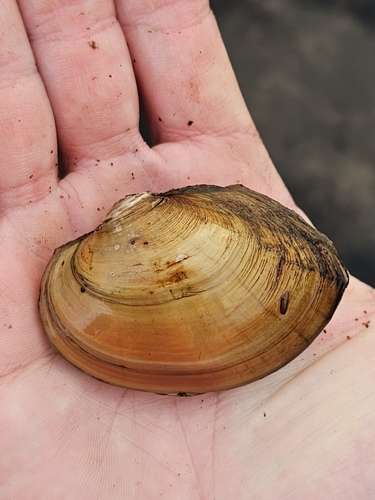
Typically 2.5 to 4 inches (60–100 mm) in length; lightweight and relatively thin-shelled.
Colors
Shell ranges from yellowish-tan to olive-brown; often features delicate green rays emanating from the hinge; the interior (nacre) is white to bluish-white.
Key Features
- Subovate or elliptical shell shape
- Thin and relatively fragile shell compared to other muckets
- Fine green rays concentrated on the posterior slope
- Smooth, shiny outer periostracum
When You’ll See Them
Behavior
The Tidewater Mucket is a quiet but vital resident of Atlantic coastal freshwater systems. Unlike many of its more robust relatives that thrive in rocky rapids, this species is a specialist of slow-moving waters and tidal reaches. It spends the majority of its life partially buried in soft substrate, with only its siphons exposed to the water column. As a filter feeder, it plays a critical role in the ecosystem by removing bacteria, algae, and organic debris, effectively acting as a natural water purification system.
Perhaps its most remarkable behavior is its reproductive strategy. Female Tidewater Muckets have a specialized mantle flap that they can expand to mimic the appearance of a small minnow or aquatic insect. By pulsating this 'lure,' they attract predatory fish like White Perch or Striped Bass. When the fish attempts to eat the lure, the mussel releases its larvae (glochidia), which attach to the fish's gills. This harmless hitchhiking allows the young mussels to disperse upstream and throughout the watershed, a necessary tactic for a creature that otherwise moves only inches at a time.
EverydayEarth exclusive
Camera Tips
Capturing the Tidewater Mucket on camera requires an underwater approach, as these bivalves are entirely aquatic. To get the best results, use a waterproof action camera or a trail camera with a high-quality underwater housing. Position the camera on a weighted base or a low-profile tripod and set it just a few inches above the river or pond bottom. Look for 'siphon holes' in sandy or silty areas—these indicate a buried mussel. Angle the lens slightly downward to capture the shell's texture and the movement of the siphons.
Timing is everything for this species. To witness the spectacular mantle lure display, set your camera during the spring and early summer when water temperatures rise. During this period, use time-lapse mode or video triggers to catch the rhythmic 'pulsing' of the lure. Because sediment can easily cloud the water, try to film after a period of dry weather when the water is at its clearest. Natural sunlight is your best friend here; positioning the camera in shallow water where sunlight hits the bottom will bring out the subtle green rays and the golden hue of the shell.
If your camera has a macro setting or a close-focus lens, use it. The Tidewater Mucket doesn't move fast, so you don't need a high shutter speed, but you do need clarity to see the fine details of the shell's growth rings. Avoid using heavy artificial baits, as these can attract scavengers that kick up silt and obscure the view. Instead, focus on finding a 'bed' of mussels where multiple individuals are present. If you are filming in a tidal area, remember to secure your equipment against the shifting currents to prevent the camera from being buried or swept away.
Similar Species
Species that look similar or are commonly confused with Tidewater Mucket.
Eastern Lampmussel
The Eastern Lampmussel has a much thicker, heavier shell and the green rays are usually more prominent across the entire shell rather than just the back.
Yellow Lampmussel
The Yellow Lampmussel is more globose (inflated) and has a brighter yellow color with fewer or no rays compared to the Tidewater Mucket.
Frequently Asked Questions
Record Tidewater Mucket at your habitat
Connect a camera to start building your own species record — AI identifies every visitor automatically.