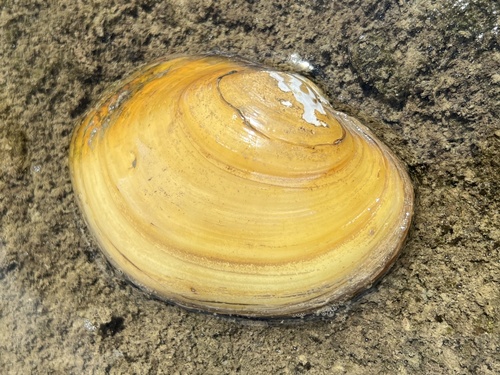
Yellow Lampmussel
Lampsilis cariosa
Meet the river's most deceptive resident: a mussel that 'fishes' with a minnow-shaped lure. The Yellow Lampmussel is a stunning, bright bivalve that keeps our waterways clean while performing one of nature's most clever tricks.
Quick Identification
Size
Shells typically range from 3 to 5 inches (75 to 125 mm) in length; they are moderately thick and relatively heavy.
Colors
Bright yellow to yellowish-brown or olive-green exterior; the inner shell (nacre) is typically white or bluish-white.
Key Features
- Smooth, shiny yellow or yellowish-green shell
- Distinctly oval or egg-shaped outline
- Mantle flaps in females that mimic a small minnow
- Prominent, slightly elevated beak (umbo) near the hinge
When You’ll See Them
Behavior
The Yellow Lampmussel is a sedentary filter feeder that lives much of its life partially buried in the sediment of riverbeds. It functions as a natural water purifier, siphoning gallons of water daily to extract microscopic algae, bacteria, and organic particles. While they may appear motionless, they can use their muscular 'foot' to slowly reposition themselves in the substrate or bury deeper if threatened by dropping water levels.
The most fascinating aspect of their behavior is their reproductive 'fishing' technique. To ensure their larvae (glochidia) find a host fish, the female extends a specialized part of her mantle that looks exactly like a small minnow, complete with a dark eyespot and a tail. She twitches this lure to attract predatory fish like White Perch. When the fish bites, the mussel releases her larvae, which attach to the fish's gills to grow before dropping off weeks later as juvenile mussels.
In terms of human interaction, these mussels are passive and harmless, but they are highly sensitive to their environment. They serve as 'canaries in the coal mine' for river health; a thriving population of Yellow Lampmussels indicates high water quality and a balanced ecosystem, while their disappearance often signals pollution or siltation issues.
EverydayEarth exclusive
Camera Tips
To capture the Yellow Lampmussel on camera, you will need an underwater setup. A waterproof action camera (like a GoPro) or a specialized aquatic trail camera is essential. Since these mussels are stationary, the best placement is to mount the camera on a weighted base or a small tripod submerged on the riverbed. Position the lens 6 to 12 inches away from the mussel, aiming at a 45-degree downward angle to capture the 'gape' of the shell where the mantle is visible.
The ultimate shot for this species is the minnow-mimic lure behavior. This is most frequently observed in late spring and early summer (May through July) as water temperatures rise. Look for mussels in shallow, clear water where sunlight can reach the bottom. If you find a female with her lure extended, set your camera to a time-lapse mode—one photo every 15 to 30 seconds—or record in 4K video to catch the subtle, life-like twitching of the mantle flaps.
Water clarity is your biggest hurdle. Rainstorms can stir up silt and ruin your footage for days, so plan your camera deployments after a period of dry weather when the river is running clear. If the water is very shallow, use a circular polarizer filter on your waterproof housing to cut through surface reflections and glare from the sun. This will make the yellow of the shell pop against the darker riverbed.
Because mussels don't move fast, you don't need high-speed triggers. Instead, focus on lighting. In shaded backyard streams, you might need an external waterproof LED light. Position the light source to the side of the camera rather than right next to the lens; this prevents 'backscatter,' where the light reflects off floating particles in the water and creates a cloudy image. If you are patient and the water is clear, you might even film a perch or bass investigating the mussel's lure!
Similar Species
Species that look similar or are commonly confused with Yellow Lampmussel.
Frequently Asked Questions
Record Yellow Lampmussel at your habitat
Connect a camera to start building your own species record — AI identifies every visitor automatically.