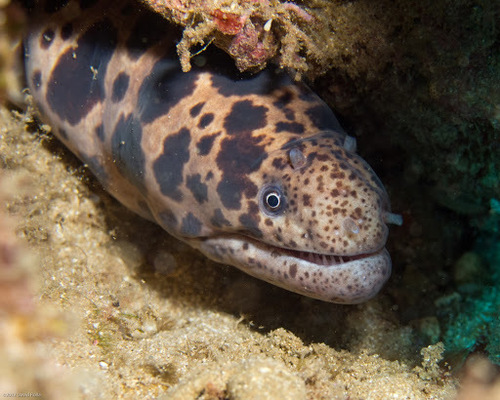
Tiger Snakemoray
Scuticaria tigrina
With its striking leopard-like spots and incredible serpentine grace, the Tiger Snakemoray is one of the reef's most beautiful and reclusive nocturnal hunters.
Quick Identification
Size
Reaches lengths of up to 1.4 meters (4.6 feet), with a slender, cylindrical body
Colors
Creamy yellow to tan base with large, irregular dark brown or black spots and 'tiger' blotches; no significant color difference between sexes
Key Features
- Elongated, snake-like cylindrical body
- Blunt, rounded snout with small eyes
- Lack of pectoral and pelvic fins
- Distinctive leopard-like or tiger-like dark spots
When You’ll See Them
Geographic range
Where Does the Tiger Snakemoray Live?
The Tiger Snakemoray is a wide-ranging inhabitant of the tropical Indo-Pacific. Its native territory spans from the eastern coast of Africa and the Red Sea across the Indian Ocean to the Hawaiian Islands and the Pacific coast of Mexico. It is commonly found in the waters of Southeast Asia, northern Australia, and the various island nations of Micronesia and Polynesia.
Basemap © OpenStreetMap contributors
Behavior
The Tiger Snakemoray is a reclusive and primarily nocturnal predator. During the daylight hours, it remains almost entirely hidden, wedging its long, muscular body into deep crevices, caves, or under coral rubble. Unlike more 'famous' morays that might gape their mouths at divers, the Tiger Snakemoray is exceptionally shy and will often retreat further into its lair if it senses movement or bright lights.
When night falls, this species becomes an active hunter, slithering through the reef matrix with serpentine movements. It is a solitary creature, rarely interacting with others of its kind except during mating. While they possess sharp teeth and a powerful grip common to all morays, they are not aggressive toward humans and generally pose no threat unless severely provoked or handled.
EverydayEarth exclusive
Camera Tips
To capture the elusive Tiger Snakemoray, you must use specialized underwater housing and equipment. Because this species is strictly marine and nocturnal, your camera should be placed near the base of a coral head or a rocky reef structure where there are visible 'bolt holes' or crevices. Look for areas with high concentrations of small crustaceans, as these are the eel's primary food source and will draw them out into the open.
Lighting is the biggest challenge when filming at night. Rather than using a harsh white strobe which may scare the eel back into its burrow, try using a diffused red light or a very low-intensity warm video light. Moray eels have relatively poor eyesight but are sensitive to sudden changes in light intensity. Position your camera on a weighted tripod to ensure stability against ocean currents and surge.
Set your AI-powered camera to record short, high-resolution video clips rather than still photos. The movement of the Tiger Snakemoray is its most distinctive feature, and seeing it 'flow' over the reef is far more rewarding. If you are using motion-triggering, be aware that surge-driven seaweed can cause false positives, so adjusting sensitivity or using a time-lapse mode during the peak nocturnal hours (10 PM to 2 AM) is often more effective.
Similar Species
Species that look similar or are commonly confused with Tiger Snakemoray.
Frequently Asked Questions
Record Tiger Snakemoray at your habitat
Connect a camera to start building your own species record — AI identifies every visitor automatically.