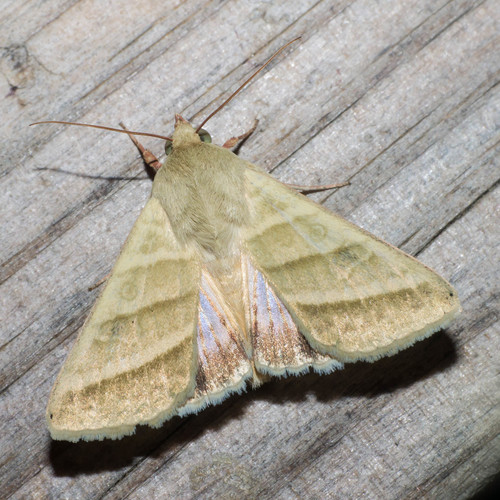
Tobacco Budworm Moth
Chloridea virescens
A delicate visitor of the night, the Tobacco Budworm Moth features subtle green hues and elegant stripes. While often hidden during the day, it becomes a star of the garden after the sun goes down.
Quick Identification
Size
Wingspan of 28 to 35 mm (1.1 to 1.4 inches); body length of 12 to 15 mm (0.5 to 0.6 inches).
Colors
Light green to yellowish-tan forewings with three slanted dark bands; hindwings are creamy white with a broad, dark brownish-gray border.
Key Features
- Three distinct dark, oblique bands across the forewings
- Pale green or straw-colored primary wings
- Creamy white hindwings with dark margins
- Fine, hair-like scales giving a velvety appearance
When You’ll See Them
Geographic range
Where Does the Tobacco Budworm Moth Live?
Native to the Western Hemisphere, the Tobacco Budworm Moth occupies a vast territory stretching from the eastern and southwestern United States through Mexico and Central America, and as far south as Argentina. In the United States, it is most prevalent in the southern states where warmer winters allow for year-round residency, though it is known to migrate northward into Canada during the peak of summer. This wide-ranging species is a familiar sight across the American tropics and subtropics, thriving wherever commercial crops and garden flowers are abundant.
Basemap © OpenStreetMap contributors
Behavior
The Tobacco Budworm Moth is a nocturnal specialist, primarily active under the cover of darkness. During the day, it relies on its cryptic coloration to blend seamlessly into green foliage, resting on the undersides of leaves to avoid detection by birds and predatory insects. Its flight is fast and somewhat erratic, a strategy used to evade bats, which are among its most common nocturnal predators.
Adults are pollinators that spend their nights visiting flowers to drink nectar. While the adults are harmless to plants, they are most famous for their reproductive behavior. Females are highly selective when choosing a site to lay eggs, searching for the tender terminal buds of host plants. They communicate with males using species-specific pheromones that can be detected from significant distances in the night air.
EverydayEarth exclusive
Camera Tips
To capture the Tobacco Budworm Moth on your backyard camera, focus on their love for specific flowers. Petunias, geraniums, and nicotiana (flowering tobacco) are magnets for these moths. Position your camera on a tripod or mount it 2 to 3 feet off the ground, angled directly toward the blooms of these plants. Since they are nocturnal, ensure your camera's infrared (IR) or night-vision settings are optimized for close-range subjects to prevent the white wings from appearing 'blown out' in the flash.
One of the most effective ways to lure these moths into camera range is through 'mothing' techniques. You can create a simple sugar bait by mashing overripe bananas with brown sugar and a splash of fermented juice or beer. Paint this mixture onto a tree trunk or a wooden post within view of your camera. The sweet, fermented aroma acts as a powerful attractant for many noctuid moths, including the Tobacco Budworm, drawing them in for high-detail still shots.
For the best results, use a camera with a fast trigger speed or set it to record short video clips (10-15 seconds). The way these moths hover or rapidly vibrate their wings while feeding can be a beautiful sight on video. Check your camera daily during the summer months, especially after warm, humid nights, as these are the peak activity times for this species. If your camera allows for manual focus, set it to the distance of your bait or flowers to ensure the intricate wing bands are in sharp focus.
Similar Species
Species that look similar or are commonly confused with Tobacco Budworm Moth.
Frequently Asked Questions
Record Tobacco Budworm Moth at your habitat
Connect a camera to start building your own species record — AI identifies every visitor automatically.