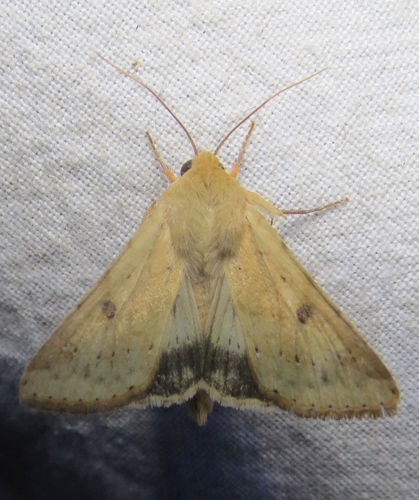
Corn Earworm Moth
Helicoverpa zea
Though famous as a garden pest in its larval stage, the adult Corn Earworm Moth is a beautiful nocturnal traveler with striking gold eyes and a vast migratory range across the Americas.
Quick Identification
Size
Wingspan of 32–45 mm (1.25–1.75 in); body length approximately 20 mm (0.8 in)
Colors
Buff-tan or yellowish-brown forewings with a distinct dark central spot; creamy white hindwings with a broad, dark terminal border
Key Features
- Distinctive dark comma-shaped spot in the center of each forewing
- Large, prominent greenish-gold compound eyes
- Pale hindwings with a wide, smudged dark band along the outer edge
- Stout, fuzzy body typical of noctuid moths
When You’ll See Them
Geographic range
Where Does the Corn Earworm Moth Live?
Native to the Americas, the Corn Earworm Moth is found throughout the Western Hemisphere. It maintains a permanent presence from the southern United States through Central America and deep into South America, reaching as far south as Argentina. During the warmer months, these moths are famous for their northward migrations, pushing into the northern United States and southern Canada to take advantage of seasonal crops.
Basemap © OpenStreetMap contributors
Behavior
The Corn Earworm Moth is a highly mobile nocturnal species known for its remarkable navigational abilities. While the larvae are infamous for their voracious appetite for crops, the adult moths spend their nights seeking out nectar-rich flowers and suitable egg-laying sites. They are strong flyers, capable of traveling long distances on prevailing winds, which allows them to recolonize northern territories every spring.
In the backyard setting, these moths are frequently seen fluttering around porch lights or garden beds. They are primarily solitary, though they may congregate in high numbers where food sources like corn or tomatoes are abundant. During the day, they remain well-camouflaged against tree bark or dried leaves, relying on their earthy tones to avoid predators like birds and bats.
EverydayEarth exclusive
Camera Tips
To capture the Corn Earworm Moth on your backyard camera, focus your efforts on the peak of summer when populations are highest. Because they are strictly nocturnal, you will need a camera with a high-quality infrared (IR) flash or a dedicated macro setup with an external light source. Position your camera about 3 to 4 feet off the ground, facing a patch of flowering plants or directly at a 'moth station'—a flat, light-colored surface like a white sheet illuminated by a UV or mercury vapor light.
For the best results, use a 'sugar bait' to lure them into the camera's field of view. You can create a slurry of overripe bananas, brown sugar, and a splash of beer. Paint this mixture onto a tree trunk at eye level and aim your camera at the patch. The moths are highly attracted to the fermenting scent and will often stay still long enough for a clear photo or video clip.
Set your camera to its highest sensitivity and use a 'Burst Mode' or short 10-second video clips. Since these moths are small and move quickly, a fast trigger speed is essential. If your camera allows for close-up focus (macro), try to mount it within 2 feet of the bait site. Check your settings to ensure the IR flash isn't 'blowing out' the subject, which can happen with small, reflective insects; a piece of translucent tape over the flash can help diffuse the light for a more natural look.
Similar Species
Species that look similar or are commonly confused with Corn Earworm Moth.
Tobacco Budworm Moth
Smaller with three distinct slanted dark bands on the forewings, whereas the Corn Earworm has a more uniform buff color with a single central spot.
Fall Armyworm Moth
The Fall Armyworm moth has more complex, marbled gray and white patterns on the forewings compared to the simpler tan of the Corn Earworm.
Frequently Asked Questions
Record Corn Earworm Moth at your habitat
Connect a camera to start building your own species record — AI identifies every visitor automatically.