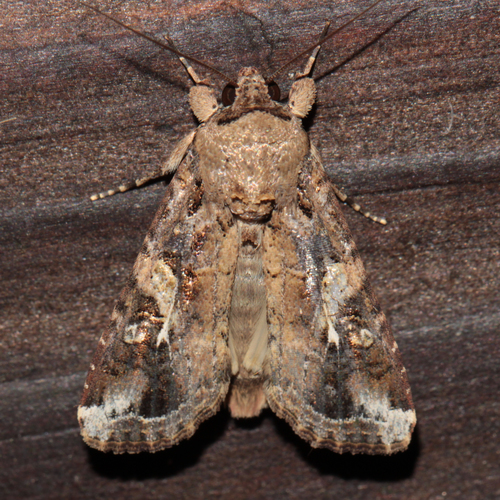
Fall Armyworm Moth
Spodoptera frugiperda
A champion of long-distance flight and a master of disguise, the Fall Armyworm Moth is a subtle nocturnal visitor with a global footprint. Watch as this understated traveler makes its annual migration across your backyard.
Quick Identification
Size
Wingspan of 32 to 40 mm (1.25 to 1.6 in); body length of approximately 17 to 20 mm (0.7 to 0.8 in)
Colors
Males have mottled gray-brown forewings with a distinct white spot at the tip and center; females are more uniform grayish-brown
Key Features
- White triangular patch at the apical margin of the forewing (males only)
- Iridescent silvery-white hindwings with a narrow dark border
- Mottled brown and gray cryptic coloring
- Fine, dark, brush-like hairs on the legs
When You’ll See Them
Geographic range
Where Does the Fall Armyworm Moth Live?
The Fall Armyworm Moth is native to the tropical and subtropical regions of the Americas, with a core range extending from the southern United States through Central America and down to Argentina. Because they lack a diapause (hibernation) stage, they can only survive year-round in frost-free climates like Florida and southern Texas. However, they are legendary migrants, pushing north each summer to reach as far as Canada. In recent years, they have become a global invasive species, rapidly spreading across sub-Saharan Africa, the Middle East, Asia, and northern Australia, making them one of the most widespread agricultural pests on Earth.
Basemap © OpenStreetMap contributors
Behavior
The Fall Armyworm Moth is a creature of the night, known for its incredible endurance and long-distance flight capabilities. While the adults are largely nocturnal and spend their nights seeking mates and nectar, they are most famous for their larval stage. In the caterpillar phase, these insects exhibit a 'gregarious' behavior where they move in massive groups across the landscape, consuming almost any vegetation in their path—an behavior that resembles an advancing army.
As adults, these moths are remarkably strong flyers, capable of traveling hundreds of miles in a single night by hitching rides on high-altitude wind currents. This allows them to quickly colonize new areas, even though they cannot survive freezing winter temperatures in northern latitudes. They are often found fluttering around porch lights or agricultural fields during the late summer and autumn months.
In the backyard setting, you will likely encounter them as solitary visitors to garden lights or resting on the undersides of leaves during the day. While they don't pose a direct threat to humans, their presence often signals a new generation of hungry caterpillars that may soon target your lawn or vegetable patch.
EverydayEarth exclusive
Camera Tips
To capture the Fall Armyworm Moth on your AI camera, the best strategy is to take advantage of their attraction to light. Set up your camera near a white light source or a UV (blacklight) trap. Since these moths are small, positioning your camera just 12 to 24 inches from the light source or a nearby resting surface—like a white sheet or a flat wall—will yield the best results for identification. Use a macro lens setting if your camera supports it, as the distinguishing white spots on the male's wings are quite small.
Placement height is most effective between 3 and 5 feet off the ground, as these moths tend to fly at lower altitudes when searching for host plants or mates. If you are tracking the larval stage (the caterpillars), aim your camera at the base of corn stalks or along the edges of a lush lawn. For the best chance of 'army' activity, check your camera feeds during humid, warm nights when the temperature stays above 60°F (15°C).
If you are trying to lure them specifically for photography, a 'sugar bait' made of fermented fruit, molasses, and a dash of beer painted onto a tree trunk can be highly effective. The moths will land to feed, allowing for a stationary shot that is much clearer than a mid-air flight capture. Ensure your camera's shutter speed is fast enough to freeze their vibrating wing movements, or use a flash to stop the action.
Similar Species
Species that look similar or are commonly confused with Fall Armyworm Moth.
Corn Earworm Moth
The Corn Earworm is typically larger with more yellow or tan wings and lacks the bright white apical spot found on male Fall Armyworms.
Beet Armyworm Moth
Beet Armyworms are smaller and have a distinctive orange or yellowish circular spot in the center of the forewing.
Yellow-striped Armyworm Moth
This species has much more intricate, high-contrast white patterns on the forewings compared to the mottled appearance of the Fall Armyworm.
Frequently Asked Questions
Record Fall Armyworm Moth at your habitat
Connect a camera to start building your own species record — AI identifies every visitor automatically.