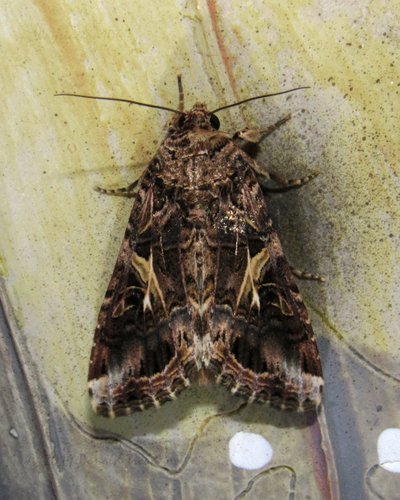
Yellow-striped Armyworm Moth
Spodoptera ornithogalli
A nocturnal master of disguise, the Yellow-striped Armyworm Moth displays stunning geometric patterns on its wings. Discover the hidden beauty of this common backyard visitor and learn how to attract it to your camera lens.
Quick Identification
Size
Wingspan ranges from 32 to 44 mm (1.25 to 1.75 inches); body length is approximately 15 to 20 mm (0.6 to 0.8 inches).
Colors
Forewings are a complex mosaic of dark brown, gray, and tan with sharp white accents. Hindwings are translucent white with a thin, dark smoky border. Males often show more high-contrast markings than females.
Key Features
- Distinctive pale, diagonal 'V' or 'Y' shaped mark on the forewings
- Intricate geometric patterns resembling wood grain or bark
- Pearly white hindwings that contrast sharply with dark forewings
- Stout, fuzzy thorax and a tapered abdomen
When You’ll See Them
Behavior
The Yellow-striped Armyworm Moth is a classic nocturnal flier, spending its daylight hours perfectly camouflaged against tree bark or leaf litter. While the larval stage (the caterpillar) is well-known for its voracious appetite for garden vegetables, the adult moth is a graceful navigator of the night. It is highly sensitive to light and pheromones, often traveling significant distances to find suitable mates and host plants for its eggs.
Unlike some moths that are specialized, this species is a generalist. It is frequently found in suburban backyards where gardens provide a bounty of resources. While the adults primarily focus on reproduction, they can occasionally be seen sipping nectar from night-blooming flowers to fuel their energetic flights. They are not aggressive and serve as an important food source for bats and nocturnal birds.
EverydayEarth exclusive
Camera Tips
To capture the intricate details of the Yellow-striped Armyworm Moth, your best strategy is a 'mothing' station rather than a traditional trail cam setup. Hang a white cotton sheet over a clothesline or between two trees and illuminate it with a UV (black) light or a mercury vapor bulb. This creates a high-contrast landing pad that attracts the moths, allowing your AI camera to trigger as they settle on the fabric. Position your camera about 2 to 3 feet from the sheet to get clear macro shots of their wing patterns.
If you prefer a more natural setup, focus your camera on night-blooming flowers like Moonflowers (Ipomoea alba) or Evening Primrose. These moths are attracted to the pale colors and sweet scents of these blooms. Set your camera to a fast trigger speed and use a high-quality flash or external infrared illuminator to freeze their movement, as their wingbeats are exceptionally rapid even when hovering.
Because these moths are relatively small, standard PIR (Passive Infrared) motion sensors on trail cameras may struggle to detect them. We recommend using a camera with 'Video Motion Detection' (VMD) settings or setting the sensitivity to 'High.' If your camera allows, use a macro lens attachment or a 'near-focus' setting to ensure the geometric patterns on the wings aren't blurred. For the best variety, aim for warm, humid nights with little to no moonlight, as these are the peak activity periods for Noctuidae moths.
Similar Species
Species that look similar or are commonly confused with Yellow-striped Armyworm Moth.
Fall Armyworm Moth
The Fall Armyworm Moth is generally smaller and lacks the sharp, high-contrast white geometric 'V' markings on the forewings.
Large Yellow Underwing
While similar in size, the Yellow Underwing has bright orange-yellow hindwings instead of the pearly-white hindwings of the Yellow-striped Armyworm.
Frequently Asked Questions
Record Yellow-striped Armyworm Moth at your habitat
Connect a camera to start building your own species record — AI identifies every visitor automatically.