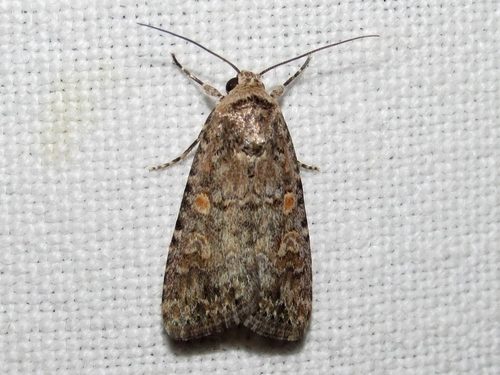
Beet Armyworm Moth
Spodoptera exigua
A master of nighttime disguise, the Beet Armyworm Moth is a world-traveling survivor found in backyards across the globe. Recognizable by its subtle mottled patterns and distinctive orange wing spots, it is a fascinating example of insect resilience.
Quick Identification
Size
Wingspan of 25–32 mm (1.0–1.25 in); body length approx 12–15 mm (0.5 in)
Colors
Mottled gray-brown forewings with a distinct pale-orange round spot and a bean-shaped spot; translucent white hindwings with dark veins
Key Features
- Dull mottled gray or dusty brown forewings
- Small, round, orange-tinted orbicular spot near wing center
- Silvery-white translucent hindwings with a thin dark border
- Resting posture with wings folded flat over the back
- Small, fuzzy thoracic tuft of hair
When You’ll See Them
Geographic range
Where Does the Beet Armyworm Moth Live?
Originally native to Southeast Asia, the Beet Armyworm has become one of the most successful globetrotting insects in the world. It is now established across nearly every continent, thriving particularly in the southern United States, Mexico, and throughout the Mediterranean and African regions. Because they are strong flyers, they frequently migrate into northern Europe and the northern U.S. during the summer months, though they typically cannot survive the frost of those higher latitudes.
Basemap © OpenStreetMap contributors
Behavior
The Beet Armyworm Moth is a nocturnal strategist, spending its daylight hours hidden in dense foliage or leaf litter to avoid predation. Once darkness falls, these moths become highly active flyers, navigating by the moon and artificial light sources. While the adults are relatively harmless nectar-feeders, they are best known for their reproductive efficiency; a single female can lay hundreds of eggs, often in fuzzy, white-covered clusters on the underside of leaves.
These moths are remarkable long-distance travelers. They utilize high-altitude wind currents to migrate hundreds of miles, allowing them to colonize northern regions where they cannot survive the winter. In a backyard setting, they are solitary but can appear in large numbers during peak emergence periods, especially in areas with well-watered gardens or nearby agricultural fields.
EverydayEarth exclusive
Camera Tips
Capturing the Beet Armyworm Moth on camera requires a focus on nighttime attractants. Since they are highly phototactic (attracted to light), the most effective way to photograph them is by setting up a 'moth station.' Hang a white cotton sheet over a fence or line and illuminate it with a UV blacklight or a strong LED. Place your camera on a tripod roughly 2-3 feet from the sheet, using a macro lens or a camera with a strong close-focus capability.
If you are using a trail camera, ensure it has a 'macro' mode or use a close-up lens attachment, as these moths are too small for standard wide-angle trail cam sensors. Position the camera near host plants like asparagus fern, sugar beets, or common garden weeds. A high-speed trigger is less important than a camera that can handle low-light conditions with minimal grain; if your camera has a manual flash setting, dial it back to avoid 'blowing out' the silvery white of the hindwings.
Another excellent method for attracting them is 'sugaring.' Create a fermented bait using overripe bananas, brown sugar, and a splash of beer. Paint this mixture onto tree trunks at eye level around dusk. Set your camera to take bursts or short video clips when it detects motion at the bait station. This often captures the moth with its proboscis extended, providing a fascinating look at their feeding behavior that light-trapping alone won't show.
Similar Species
Species that look similar or are commonly confused with Beet Armyworm Moth.
Frequently Asked Questions
Record Beet Armyworm Moth at your habitat
Connect a camera to start building your own species record — AI identifies every visitor automatically.