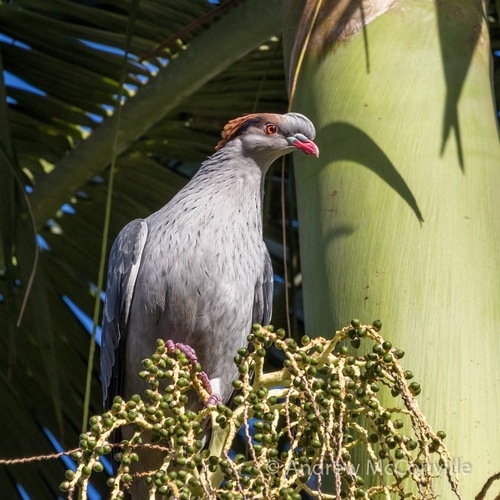
Topknot Pigeon
Lopholaimus antarcticus
Meet the 'Flock-Pigeon' of the rainforest canopy. The Topknot Pigeon is a spectacular, crested wanderer that brings a touch of wild Australia to suburban heights.
Quick Identification
Size
Length: 40–46 cm (16–18 in); Wingspan: approx 80 cm (31 in); Weight: 450–600g (1–1.3 lbs)
Colors
Slate-grey body with a pale grey breast; dark grey wings and tail with a lighter horizontal band; distinctive crest with a grey front and rusty-cinnamon back.
Key Features
- Swept-back bicolored crest (grey and rusty-red)
- Large, plump body significantly bigger than a common pigeon
- Pale grey band across a dark tail
- Reddish-brown eye ring and base of beak (cere)
When You’ll See Them
Behavior
The Topknot Pigeon is a nomadic and highly social species, known for traveling in large, impressive flocks that can number in the hundreds. Unlike many other Australian pigeons, they are strictly arboreal, meaning they spend almost their entire lives high in the canopy of rainforests or tall suburban trees. They are incredibly agile for their size, often hanging upside down to reach ripe fruits at the ends of thin branches.
These birds are restless wanderers, moving according to the availability of seasonal fruits. While they were once considered shy forest dwellers, they have increasingly adapted to suburban environments along the Australian east coast, particularly where mature fruiting trees like palms and figs are present. Their flight is powerful and direct, characterized by loud, whistling wing beats that can often be heard before the birds are seen.
EverydayEarth exclusive
Camera Tips
To capture the Topknot Pigeon on your EverydayEarth camera, you must think vertically. Because these pigeons rarely touch the ground, a camera mounted at eye level or pointed at a lawn will likely miss them. Instead, mount your camera on a high balcony, a second-story deck, or use a specialized tree mount to point the lens toward the mid-to-upper canopy of fruiting trees. They are particularly fond of Bangalow Palms and Cabbage Tree Palms when the fruit is ripe.
If you don't have high fruiting trees, focus your camera on a high-platform birdbath. While they get most of their hydration from fruit, Topknot Pigeons will descend to elevated water sources, especially during hot, dry spells. Ensure the camera is positioned to catch the morning light, as they are most active shortly after sunrise when they begin their daily foraging flights. Use a fast trigger speed setting; despite their size, their movements among branches can be quick and erratic as they jostle for the best fruit.
Seasonal timing is everything for this species. Keep an eye on the trees in your neighborhood—when the Lilly Pillies or figs start to ripen, move your camera to face those specific branches. Since they travel in flocks, set your camera to record longer video clips (20-30 seconds). Capturing a single bird often means a dozen more are about to land, and the social interactions, such as their distinctive head-bobbing and wing-flicking, are best captured in motion rather than still photos.
Similar Species
Species that look similar or are commonly confused with Topknot Pigeon.
Frequently Asked Questions
Record Topknot Pigeon at your habitat
Connect a camera to start building your own species record — AI identifies every visitor automatically.