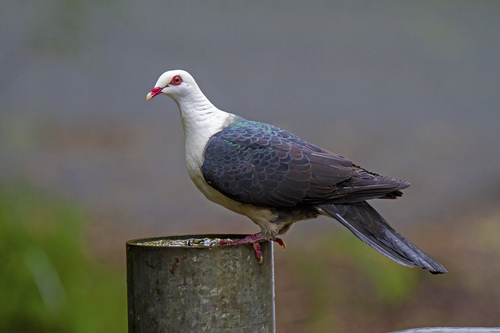
White-headed Pigeon
Columba leucomela
With its striking snowy plumage and deep slate wings, the White-headed Pigeon is a gem of the Australian east coast. Often found hidden in the canopy of fruiting trees, this elegant bird is a testament to how rainforest species can thrive in our backyards.
Quick Identification
Size
Length: 38–42 cm (15–16.5 in); Wingspan: 60–70 cm (23.5–27.5 in); Weight: 400–500 g (14–17.6 oz)
Colors
Pure white head, neck, and breast (males) or grayish-white (females); dark slate-gray to black wings and back with iridescent green or purple highlights; reddish bill with a yellow tip.
Key Features
- Distinctive white head and chest contrasting with dark body
- Bright red or pinkish base of the bill
- Yellowish-orange eye ring
- Large, stocky pigeon build typically found in canopy foliage
When You’ll See Them
Behavior
The White-headed Pigeon is a somewhat secretive but increasingly common visitor to Australian coastal gardens. Unlike many other pigeon species that forage on the ground, these birds are primarily arboreal, spent much of their time high in the canopy searching for fruit. They are known for their powerful, noisy wing-beats when taking flight, which often gives away their location before they are seen. While they can be shy in dense rainforest, they have become remarkably well-adapted to suburban life where mature fruiting trees are present.
These pigeons are often nomadic, traveling in small groups or pairs to follow the seasonal ripening of various fruits. They are generally peaceful and do not exhibit the aggressive territorial behavior seen in some larger wattlebirds. In a backyard setting, they are most frequently observed arriving in the early morning to feed or visiting bird baths during the heat of the day to drink and preen.
EverydayEarth exclusive
Camera Tips
To capture the White-headed Pigeon, the single most effective strategy is to position your camera near a large, elevated bird bath. These birds are heavy drinkers, especially after consuming large quantities of fruit, and they prefer baths that are sturdy and placed at least 3 to 5 feet off the ground. Aim your camera at a slight downward angle toward the water's edge, ensuring you have enough depth of field to capture the bird's entire body as it leans in to drink.
If you are placing a camera near a known feeding tree, such as a Lily Pilly or a Camphor Laurel, don't place the camera on the ground. Instead, use a strap or mount to secure the camera to a nearby branch at eye level, roughly 6 to 10 feet away from the fruit clusters. Because these pigeons are larger than your average garden bird, use a 'Medium' PIR sensitivity setting to avoid being overwhelmed by trigger events from leaves blowing in the wind or smaller insects.
Since the White-headed Pigeon is most active during the soft light of early morning, check that your camera's exposure settings handle low-light transitions well. High-definition video mode is highly recommended over still photos, as it captures the beautiful iridescent sheen of their dark feathers and their unique 'bobbing' head movement while they forage. If your camera allows for it, a 15-second video clip with a 5-second interval is the sweet spot for documenting their social interactions without filling up your SD card too quickly.
Similar Species
Species that look similar or are commonly confused with White-headed Pigeon.
Topknot Pigeon
The Topknot Pigeon has a prominent, swept-back crest and a dark gray head, unlike the smooth, pure white head of the White-headed Pigeon.
Wonga Pigeon
Wonga Pigeons are almost strictly ground-dwelling and have a distinct white 'V' on their chest with spotted flanks, whereas White-headed Pigeons stay mostly in trees.
Frequently Asked Questions
Record White-headed Pigeon at your habitat
Connect a camera to start building your own species record — AI identifies every visitor automatically.