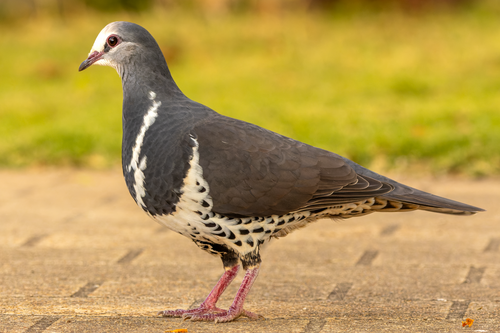
Wonga Pigeon
Leucosarcia melanoleuca
Meet the Wonga Pigeon, the dapper, ground-dwelling giant of the Australian forest floor. With its striking black-and-white 'V' markings and rhythmic call, this bird brings a touch of wild rainforest mystery to suburban gardens.
Quick Identification
Size
Length: 36-43 cm (14-17 in); Weight: 330-500 g (11.6-17.6 oz)
Colors
Slaty-grey upperparts, white face with a dark eye-streak, and white underparts decorated with bold black V-shaped markings or spots.
Key Features
- Large, plump, ground-dwelling silhouette
- Bold black 'V' or 'U' shaped markings on white flanks and belly
- White forehead and face contrasting with grey wings
- Constant rhythmic 'whoop-whoop' call
- Red-pink eye-ring
When You’ll See Them
Behavior
The Wonga Pigeon is a ground-specialist, preferring to spend its time walking through the undergrowth rather than flying. It has a characteristic gait, walking with a steady, bobbing head and a sturdy stride. Unlike many other pigeons that take flight at the first sign of danger, the Wonga will often run into the thicket or fly only a short distance to a low branch when disturbed.
In the backyard setting, they are typically solitary or seen in pairs. While naturally shy, they can become quite habituated to humans if they feel secure, often visiting the same garden patches at the same time each day. Their social interactions are usually quiet, though males are famous for their incredibly persistent, rhythmic 'whoop-whoop' call, which can carry for hundreds of meters through dense forest to signal their territory.
EverydayEarth exclusive
Camera Tips
Because Wonga Pigeons are almost strictly ground-dwellers, your camera placement should be significantly lower than for other birds. Mount your AI camera or trail cam between 20cm and 40cm (8-16 inches) off the ground. Aiming the lens level across a clear patch of leaf litter or a garden path will capture their striking chest markings perfectly. They love 'corridors'—natural paths through gardens or gaps in the undergrowth—so look for areas where they can walk freely without having to take flight.
To increase your chances of a capture, try raking a small patch of soil or leaf litter in front of the camera. The fresh earth often attracts them as they search for insects and fallen seeds. If you have a birdbath, place the camera nearby but focus on the ground area leading to the water; Wonga Pigeons almost always drink from ground-level water sources or low-profile basins rather than elevated or hanging birdbaths.
In terms of settings, these birds move with a steady, rhythmic bob. To avoid motion blur and catch the detail in their black-and-white flank feathers, ensure the area is well-lit by natural dappled sunlight. Since they are most active in the early morning and late afternoon, ensure your camera's PIR (motion) sensor sensitivity is set to high to catch them in the lower light levels of the forest floor.
Finally, patience is key with this species. They are creatures of habit. Once you see a Wonga Pigeon on camera at a specific time, it is highly likely to return to that exact spot within 15 to 30 minutes of that time the following day. If your camera has a video mode, use it—the sight of a Wonga Pigeon 'pumping' its head as it walks is one of the most charming behaviors to witness on a backyard stream.
Similar Species
Species that look similar or are commonly confused with Wonga Pigeon.
Frequently Asked Questions
Record Wonga Pigeon at your habitat
Connect a camera to start building your own species record — AI identifies every visitor automatically.