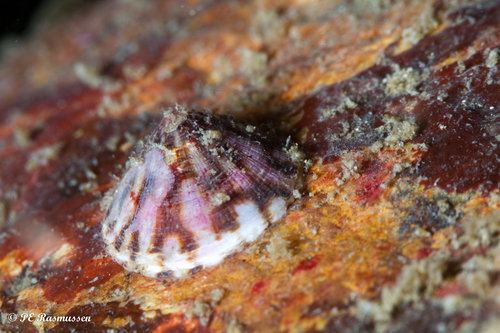
Tortoiseshell Limpet
Testudinalia testudinalis
The Tortoiseshell Limpet is a master of the rocky Atlantic coast, sporting a beautifully patterned shell that provides perfect camouflage among stones and seaweed. Known for its incredible 'homing' instinct, this resilient snail navigates the crushing power of the sea with ease.
Quick Identification
Size
Shell length ranges from 2 to 5 cm (0.8 to 2 inches); shell height is typically 1/3 of the length.
Colors
Tessellated pattern of dark brown or reddish-brown radiating lines and blotches on a cream or pale grey background; interior is bluish-white with a dark chocolate central 'owl' mark.
Key Features
- Cap-shaped, oval conical shell
- Striking brown-and-white 'tortoiseshell' radiating pattern
- Smooth shell exterior without coarse ribbing
- Strong, muscular suction foot for adhering to rock
When You’ll See Them
Geographic range
Where Does the Tortoiseshell Limpet Live?
Native to the cold-temperate and Arctic waters of the Northern Hemisphere, the Tortoiseshell Limpet is a staple of the North Atlantic and North Pacific coastlines. You will find them clinging to the rugged shores of New England and Eastern Canada, stretching across Greenland and Iceland into the British Isles and Scandinavia. They thrive best in high-latitude environments where the water remains cool and oxygen-rich throughout the year.
Basemap © OpenStreetMap contributors
Behavior
The Tortoiseshell Limpet is a remarkably resilient marine snail that has adapted to life in the high-energy environment of the rocky intertidal zone. Unlike many other snails that roam freely, the limpet is a 'homing' creature. It often occupies a specific spot on a rock, known as a home scar, where its shell has worn a perfect indentation into the stone to create a watertight seal. This behavior prevents the animal from drying out during low tide and protects it from being swept away by crashing waves.
These gastropods are most active when submerged during high tide or during damp, foggy periods at night. They move slowly across the rock surface using a wave-like motion of their muscular foot. Despite their sedentary appearance, they are active foragers that can travel several feet in a single night before precisely navigating back to their home scar using chemical cues left in their mucus trails.
EverydayEarth exclusive
Camera Tips
Capturing the life of a Tortoiseshell Limpet requires a departure from standard trail camera setups. Because these creatures live in the intertidal zone, you must use a waterproof action camera (like a GoPro or specialized underwater housing) capable of time-lapse photography. Place your camera in a permanent tide pool that remains filled even at low tide. This ensures the camera stays submerged and provides the best clarity for observing the limpet’s slow-motion world.
Mounting is the biggest challenge. Use a heavy weighted base or a suction-cup mount attached to a smooth, submerged rock. Angle the lens low and horizontal to the rock surface; this 'snail’s-eye view' highlights the profile of the shell and the movement of the foot. Since limpets move at a glacial pace, set your time-lapse interval to one photo every 30 to 60 seconds. This will allow you to compress hours of foraging into a few seconds of video, revealing their surprisingly complex navigation.
Lighting is crucial in tide pools. Natural sunlight can cause heavy glare on the water's surface, so try to film on overcast days or use a polarizing filter if your camera supports it. If you are filming at night—when limpets are often most active—you will need a diffuse, low-intensity waterproof LED light. Avoid high-intensity flashes, which can wash out the intricate 'tortoiseshell' patterns on the shell. If you are using an AI-powered camera like those featured on EverydayEarth, look for motion-trigger settings that can be adjusted for very slow movement or rely on the time-lapse function to catch the action.
Similar Species
Species that look similar or are commonly confused with Tortoiseshell Limpet.
Frequently Asked Questions
Record Tortoiseshell Limpet at your habitat
Connect a camera to start building your own species record — AI identifies every visitor automatically.