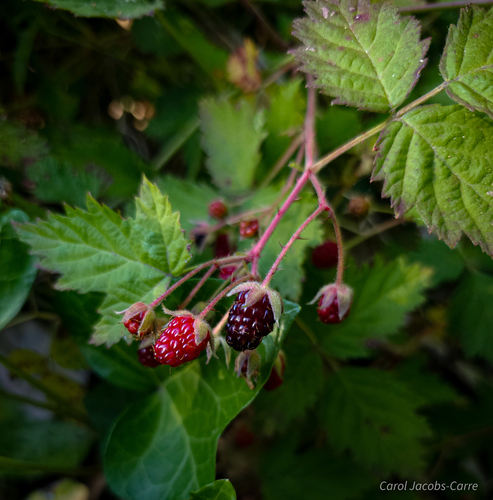
trailing blackberry
Rubus ursinus
The only blackberry native to the Pacific Northwest, this low-creeping vine is a powerhouse of the forest floor. From its delicate star-like flowers to its intensely sweet summer fruit, it is a vital hub for backyard pollinators and songbirds.
Quick Identification
Size
Trailing vines typically 1 to 6 meters (3 to 20 feet) in length; fruit is small, about 1-2 cm (0.4-0.8 inches) long
Colors
Bright green leaves, often turning reddish-purple in winter; white to pale pink five-petaled flowers; fruit matures from green to red to deep glossy black
Key Features
- Low-growing, prostrate vines that trail along the ground
- Leaves usually composed of three leaflets with jagged edges
- Small, slender, curved prickles along the stems
- Distinctive white flowers with narrow petals
- Produces the only native blackberry fruit in the Pacific Northwest
When You’ll See Them
Behavior
Trailing blackberry is a resilient native perennial that behaves quite differently from its upright, invasive cousins. Instead of forming massive, impenetrable thickets, it creeps along the forest floor or over logs, creating a delicate green carpet. It is a 'pioneer species,' often being one of the first plants to stabilize soil in areas disturbed by fire or logging. Because it stays low to the ground, it provides critical 'hidden' highways for small mammals and ground-nesting birds.
This plant is dioecious, meaning individual plants are either male or female. This social dynamic is unique among many berries; you need both a male-flowered plant and a female-flowered plant in the vicinity for the female to produce those iconic, highly flavored blackberries. For humans, it is a seasonal treasure, offering a much more intense, sweet-tart flavor than the larger, watery berries found on invasive species.
EverydayEarth exclusive
Camera Tips
To capture the secret life of the trailing blackberry, place your camera at a very low 'worm’s-eye' view. Because these vines trail along the ground, the animals that use them—like Spotted Towhees, Dark-eyed Juncos, and various rodents—will be moving just inches off the forest floor. Setting your camera 6 to 12 inches high, angled slightly downward toward a cluster of ripening berries, is the best way to catch these small visitors in action.
During the spring flowering phase, use a camera with a fast trigger speed or high-frame-rate video settings. The white flowers are a magnet for native bees and butterflies, but their visits are often lightning-fast. In the peak of summer, focus your lens on the ripening fruit. You don’t need artificial bait; the berries themselves are the ultimate natural lure. You are likely to film mammals like the North American Deermouse or even a foraging Black-tailed Deer browsing the tender leaf tips.
For the best visual results, position your camera so the sun is behind it or to the side. The waxy, blue-gray 'bloom' on the trailing blackberry stems can cause glare in direct midday sun, but the early morning light creates a beautiful highlight on the dark, glossy berries. If your camera has a macro or close-focus mode, use it here to capture the intricate details of the pollinators against the narrow petals of the flowers.
Similar Species
Species that look similar or are commonly confused with trailing blackberry.
Frequently Asked Questions
Record trailing blackberry at your habitat
Connect a camera to start building your own species record — AI identifies every visitor automatically.