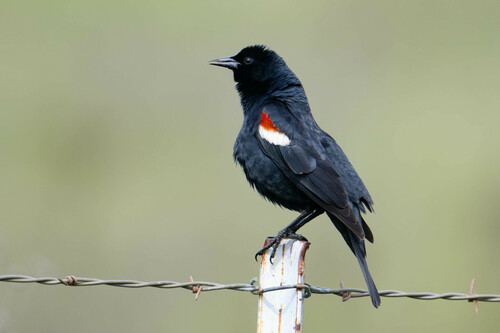
Tricolored Blackbird
Agelaius tricolor
The most social songbird of the West, the Tricolored Blackbird is a master of life in the colony. Distinguished by the striking white border on its red shoulder, this California icon is a rare and rewarding find for any backyard observer.
Quick Identification
Size
18–24 cm (7–9.5 in) in length; wingspan of 26–33 cm (10–13 in); weight 43–68 g (1.5–2.4 oz)
Colors
Males are glossy black with a dark red shoulder patch and a crisp white border. Females are dark sooty-brown with heavy grayish-white streaking.
Key Features
- Male's red shoulder patch has a white (not yellow) border
- Deep, nasal 'kerr' call unlike the musical trill of other blackbirds
- Highly social, often seen in massive, synchronized flocks
- Pointed, conical black bill
- Slender, passerine build with a slightly notched tail
When You’ll See Them
Behavior
The Tricolored Blackbird is the most social songbird in North America. Unlike many birds that defend individual territories, these blackbirds live life in a crowd, nesting in dense colonies that can number in the tens of thousands. Their behavior is highly synchronized; when a colony is active, the birds seem to move as a single organism, rising from the reeds in a shimmering cloud to forage in nearby fields before returning to the safety of the marsh together.
In a backyard setting, you'll rarely see a lone Tricolored Blackbird. They are communal foragers, meaning if one finds your feeder, several dozen are likely to follow. While they are more skittish than the ubiquitous Red-winged Blackbird, their strength-in-numbers approach gives them confidence when descending on a food source. They spend much of their day on the ground or in low vegetation, walking rather than hopping as they search for food.
EverydayEarth exclusive
Camera Tips
To capture the Tricolored Blackbird on your AI camera, you need to think about 'edge' habitats. These birds love the transition zones where a lawn or open field meets dense, brushy cover. Position your camera about 3 to 5 feet off the ground, angled toward a flat, open area. Because they travel in large groups, avoid tight framing; a wider field of view will allow you to capture the impressive social dynamics of the flock rather than just a single bird.
Water is a powerful lure for this species. A ground-level birdbath or a shallow water feature is often more effective than a feeder for getting them to hold still in front of a lens. If you are using a feeder to attract them, opt for a large platform or tray feeder rather than a hanging tube. They prefer to forage on flat surfaces where they can walk around. Use high-energy bait like cracked corn, white proso millet, or sunflower hearts to keep them lingering long enough for the camera to trigger.
Because Tricolored Blackbirds are fast-moving and social, set your camera to a 'burst' or 'multi-shot' mode. This ensures that even if the first bird triggers the sensor and flies off, you’ll catch the dozen followers behind it. If your camera supports video, the audio is a vital identification tool—the harsh, nasal 'kerr' call is the easiest way to distinguish them from the more common Red-winged Blackbird in your recordings. Peak activity usually occurs in the golden hours of the morning and evening, so ensure your camera is positioned to avoid direct lens flare during these times.
Similar Species
Species that look similar or are commonly confused with Tricolored Blackbird.
Red-winged Blackbird
The male Red-winged has a yellow border on its red shoulder patch, and the female is more rust-toned compared to the grayish-sooty female Tricolored.
Brewer's Blackbird
Males have striking yellow eyes and lack any red shoulder patches; they are also more comfortable in urban parking lots and sidewalks.
Frequently Asked Questions
Record Tricolored Blackbird at your habitat
Connect a camera to start building your own species record — AI identifies every visitor automatically.