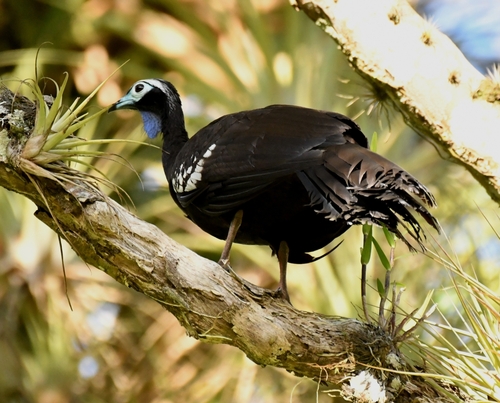
Trinidad Piping-Guan
Pipile pipile
The Trinidad Piping-Guan, or Pawi, is one of the rarest birds on the planet. Found only in the lush rainforests of Trinidad, this 'forest turkey' is a symbol of Caribbean conservation, recognizable by its stunning blue face and white-streaked wings.
Quick Identification
Size
60–69 cm (24–27 in) in length; weight approximately 2.2–3.3 kg (4.8–7.3 lbs)
Colors
Glossy black plumage with purple highlights, large white wing patches, and a cobalt-blue face and throat dewlap
Key Features
- Distinctive cobalt-blue cere and throat dewlap
- Large white patches on the wings
- Short, bushy white-tipped crest
- Reddish-pink legs and feet
- Turkey-like silhouette with a long tail
When You’ll See Them
Geographic range
Where Does the Trinidad Piping-Guan Live?
Native to the South American region, the Trinidad Piping-Guan is found exclusively on the island of Trinidad. This bird is a true island endemic, meaning it exists nowhere else in the wild. Its remaining population is heavily concentrated in the remote, dense forests of the Northern Range, with a very small, precarious population in the Southern Range, making its total geographic footprint incredibly small.
Basemap © OpenStreetMap contributors
Behavior
The Trinidad Piping-Guan, known locally as the Pawi, is a stealthy and primarily arboreal bird. It spends the majority of its life in the high canopy of humid forests, moving with surprising grace between branches to forage. Though they are large birds, they can be remarkably quiet, often only betraying their presence through the sound of falling fruit or a low, piping whistle. They are most famous for their mechanical 'wing-drumming' display, a rapid rattling sound created by their wings during early morning flights between trees.
Socially, the Pawi is usually found in pairs or small family groups. They are generally shy and wary of humans, a trait likely developed after decades of hunting pressure. However, in protected areas like the Grande Riviere, they have become slightly more visible to observers. They are early risers, beginning their activity at the crack of dawn and settling into high, leafy roosts before dusk to avoid predators.
EverydayEarth exclusive
Camera Tips
To capture the elusive Pawi on camera, you must think vertically. These birds are canopy specialists, so a standard ground-level trail camera is unlikely to yield results unless it is placed near a known forest pool or a 'salt lick' where they occasionally descend to drink or seek minerals. For the best results, mount your camera 15 to 30 feet up in the canopy, focusing on the limbs of fruiting Matchwood (Jereton) trees or Euterpe palms. Using a specialized tree mount or a secure climbing harness to position the camera is essential.
Because the Pawi is most active during the low-light hours of dawn, ensure your camera has a high-quality sensor capable of handling dim light without excessive grain. A fast trigger speed is vital, as these birds move quickly when leaping between branches. Set your camera to record short video clips (15-30 seconds) rather than just stills; the Pawi’s social interactions and unique 'wing-drumming' displays are much better captured in motion and provide valuable data for conservationists.
Avoid using cameras with a visible red glow or white flash, as this can startle the birds and potentially drive them away from their favorite feeding spots. Use 'No-Glow' black LED infrared flashes to remain completely invisible. If you are setting up near a home that borders the Northern Range forest, planting native fruit trees and keeping a quiet, low-traffic garden can encourage them to visit the lower canopy where they are easier to film. Remember that these birds are critically endangered, so minimize your visits to the camera site to reduce human scent and disturbance.
Similar Species
Species that look similar or are commonly confused with Trinidad Piping-Guan.
Frequently Asked Questions
Record Trinidad Piping-Guan at your habitat
Connect a camera to start building your own species record — AI identifies every visitor automatically.