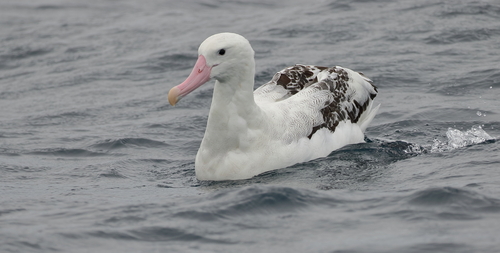
Tristan Albatross
Diomedea dabbenena
A critically endangered master of the winds, the Tristan Albatross is one of the world's most magnificent and rarest seabirds. With a wingspan that rivals a small glider, it represents the wild, untamed spirit of the South Atlantic.
Quick Identification
Size
Length: 110 cm (43 in); Wingspan: 300–350 cm (9.8–11.5 ft); Weight: 6–7 kg (13–15 lbs)
Colors
White body with dark brownish-black upper wings. Juveniles are almost entirely chocolate brown, gradually whitening over several years. Adults maintain more dark feathers on their back than other great albatrosses.
Key Features
- Massive wingspan exceeding 10 feet
- Hooked, pinkish-yellow bill
- Darker dorsal plumage compared to Wandering Albatrosses
- Heavy, cigar-shaped body in flight
When You’ll See Them
Behavior
The Tristan Albatross is a nomadic giant of the skies, spending the vast majority of its life soaring over the open waters of the South Atlantic. They utilize a flight technique called dynamic soaring, which allows them to travel hundreds of miles a day by catching wind currents just above the waves, barely flapping their wings. At sea, they are generally solitary but can be seen gathering in small groups where food is plentiful, particularly around fishing vessels.
When it comes time to breed, they return to the remote cliffs and moorlands of the Tristan da Cunha island group. Their social behavior is famous for its complexity; they engage in elaborate courtship 'dances' that involve synchronized bill-snapping, sky-pointing, and vocalizations. These birds are extremely slow-maturing and typically only raise a single chick every two years, forming deep, monogamous bonds that last for decades.
EverydayEarth exclusive
Camera Tips
Capturing the Tristan Albatross on camera is a rare privilege usually reserved for researchers or those on remote South Atlantic expeditions. If you are monitoring a nesting site, position your trail camera on a low tripod or a stable rock approximately 15-20 inches off the ground. This low angle emphasizes the bird's scale and captures the intricate details of their ground-based courtship rituals. Ensure the camera is pointed toward a known display 'leks' or a nesting mound, as these birds return to the same spots year after year.
Because the South Atlantic environment is notoriously harsh, your camera must be rated for extreme weather and salt-spray resistance. Use a high-quality PIR sensor to trigger the camera, and set the shutter speed to at least 1/1250s if you hope to capture sharp images of them landing or taking off. Their white plumage is highly reflective, so adjust your exposure compensation to -0.7 or -1.0 to avoid 'blowing out' the highlights in bright daylight, which would hide the subtle feather patterns used for identification.
For those attempting to document these birds from a vessel or a coastal cliff, use a long-range telephoto lens (at least 500mm equivalent). Set your camera to 'Burst Mode' or 'High-Speed Continuous' shooting. The speed at which these birds glide past a fixed point is deceptive; they can travel at 50-70 mph with ease. A camera with AI-subject tracking for birds is a game-changer here, as it can lock onto the bird's eye even against the chaotic backdrop of crashing waves and sea foam.
Lastly, consider the battery and storage needs for such a remote location. High-capacity SD cards (256GB+) and external lithium battery packs are essential, as cold winds can drain standard batteries quickly. If you are using a camera for long-term monitoring of a nest, a small, reinforced solar panel can provide the power needed for a full breeding season. Avoid using any artificial lighting or flashes, as this can disorient the birds or attract invasive species like mice that threaten the chicks.
Similar Species
Species that look similar or are commonly confused with Tristan Albatross.
Frequently Asked Questions
Record Tristan Albatross at your habitat
Connect a camera to start building your own species record — AI identifies every visitor automatically.