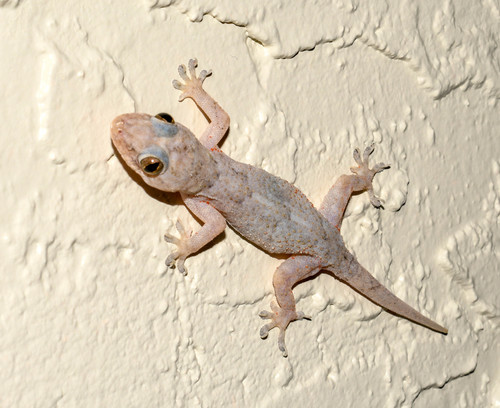
Tropical House Gecko
Hemidactylus mabouia
The ultimate 'wall-walker' of the night, the Tropical House Gecko is a tiny, vocal predator that has turned our suburban porches into its personal hunting grounds. Watch closely as these translucent hunters use molecular physics to defy gravity and patrol the shadows of your home.
Quick Identification
Size
3 to 5 inches (7.5 to 12.7 cm) in total length; weight is typically between 4 to 6 grams.
Colors
Highly variable, ranging from pale translucent cream or white to grayish-brown; usually features dark, wavy bands or chevrons across the back and tail; underside is pale and often see-through.
Key Features
- Expanded toe pads for vertical climbing
- Large lidless eyes with vertical pupils
- Bumpy skin texture caused by small pointed scales (tubercles)
- Frequently seen near outdoor artificial light sources
When You’ll See Them
Behavior
The Tropical House Gecko is a master of the suburban landscape, having successfully transitioned from the wild savannas of Africa to the vertical walls of our homes. They are famously vocal for lizards, often producing a series of sharp 'chik-chik-chik' sounds to defend their territory or attract mates. Unlike many shy reptiles, these geckos are bold around human activity, having learned that our porch lights act as a dinner bell for their favorite snacks.
These lizards are highly territorial and will often return to the same specific 'hunting station' on a wall every single night. They utilize a sit-and-wait predatory strategy, staying perfectly still for several minutes before launching a lightning-fast strike at a moth or beetle. Their ability to walk upside down on glass and ceilings is thanks to millions of microscopic hairs on their toes that create a molecular bond with the surface.
EverydayEarth exclusive
Camera Tips
Capturing high-quality footage of a Tropical House Gecko requires a different strategy than filming larger mammals. Because they are ectotherms (cold-blooded) and very small, standard Passive Infrared (PIR) sensors on trail cameras may struggle to detect their body heat. To overcome this, place your camera very close to a known hunting spot—usually within 2-3 feet of an outdoor light fixture or a crack in the siding where they hide during the day. Use a camera with a 'macro' or close-focus lens if available to avoid blurry images.
Placement is everything with these vertical acrobats. Instead of mounting your camera on a tree facing the ground, use a mount that allows you to point the camera directly along a flat wall or fence line. Positioning the camera at a slight side-angle to the wall can create more dramatic shadows, highlighting the gecko’s bumpy skin and large eyes. If your camera has adjustable PIR sensitivity, turn it to 'High' to ensure the small heat signature of the gecko triggers a recording.
Lighting is your best friend when tracking this species. Since they naturally congregate near porch lights to hunt insects, you don't necessarily need to rely solely on your camera's infrared flash. If you have a dim outdoor light, your camera may be able to record in 'day' mode at night, capturing the gecko's true colors and translucent skin. For the best action shots, aim your camera at a section of wall where insects regularly land; you’ll likely catch the gecko's high-speed predatory lunges and territorial 'push-up' displays.
Check your camera settings for 'Trigger Speed.' Geckos move in incredibly fast bursts. A slow trigger will result in a video of an empty wall because the gecko has already struck and moved on. Set your video length to at least 15-20 seconds to capture their patient stalking behavior. If you are using a backyard AI camera, look for a 'Small Animal' or 'Reptile' detection mode to help filter these clips from the background movement of moths.
Similar Species
Species that look similar or are commonly confused with Tropical House Gecko.
Frequently Asked Questions
Record Tropical House Gecko at your habitat
Connect a camera to start building your own species record — AI identifies every visitor automatically.