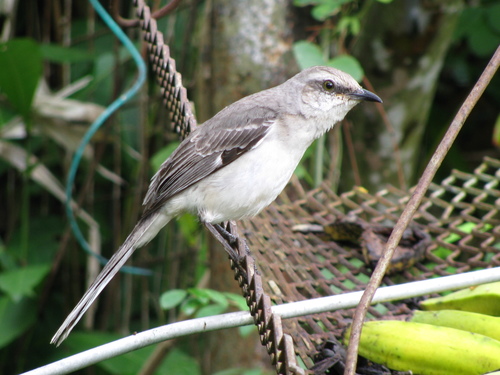
Tropical Mockingbird
Mimus gilvus
The ultimate backyard entertainer, the Tropical Mockingbird is a master of mimicry and a bold guardian of its territory. Its complex songs and unique 'wing-flash' dance make it a favorite for backyard observers.
Quick Identification
Size
Length: 25-26 cm (9.8-10.2 in); Wingspan: 33-37 cm (13-14.5 in); Weight: 50-56 g (1.8-2.0 oz)
Colors
Ash-gray upperparts with pale, creamy-white underparts. Blackish wings featuring two narrow white wing bars; long, dark gray tail with conspicuous white tips on the outer feathers.
Key Features
- Long, dark tail with white outer-feather tips
- Pale yellow or straw-colored eyes
- Faint dark line through the eye creating a 'masked' look
- Two narrow white bars on dark wings
When You’ll See Them
Behavior
The Tropical Mockingbird is a charismatic and bold songster, famous for its incredible ability to mimic other birds, mechanical noises, and environmental sounds. Unlike its North American cousin, it is a resident breeder that stays year-round in its territory and is known for being fiercely protective. You’ll often see them perched high on a fence or wire, tail cocked upward, singing a complex medley of trills and whistles that can last for minutes at a time.
In the garden, they exhibit a fascinating 'wing-flashing' behavior—opening and closing their wings in a jerky, hitching motion. Scientists believe this is used to startle insects into moving, making them easier to catch. While they are social within their family groups, they are aggressive toward intruders, often 'mobbing' much larger birds or even domestic pets that venture too close to their nesting sites.
EverydayEarth exclusive
Camera Tips
To capture the best footage of a Tropical Mockingbird, focus on low-to-medium heights. These birds spend a significant amount of time foraging on the ground or scanning from low perches like fence posts, garden walls, or low-hanging branches. Position your camera about 2 to 4 feet off the ground, angled slightly downward toward a patch of open lawn or a flat stone. If you want to encourage them to stay in the frame, place a lure like chopped papaya, orange halves, or suet nearby.
Water is a major draw for this species. If you have a birdbath or a shallow water feature, aim your camera there. Tropical Mockingbirds are frequent and enthusiastic bathers, often providing highly entertaining 'action shots' as they splash vigorously. Ensure your camera’s trigger speed is set as fast as possible—ideally under 0.4 seconds—because their movements are quick and erratic, especially during their iconic wing-flashing displays. Using a 'burst' photo mode or high-frame-rate video will help you catch that perfect moment when their wings are fully extended.
If you are interested in their famous vocalizations, ensure your camera has a high-quality microphone and is placed away from ambient noise like air conditioners. While they are most active during the day, Tropical Mockingbirds are famous for singing during full moons; if you have a camera with good infrared night vision, you might capture them singing from a prominent 'song post' even in the middle of the night. For daytime shots, try to position the camera with the sun at its back to highlight the subtle gray gradients of their plumage without washing out the white tips of their tail.
Lastly, look for their favorite 'launching pads.' These birds are habitual; they often use the same branch or post as a lookout before diving into the grass for an insect. Once you identify a bird's favorite perch, mount your camera facing that spot with a narrow field of view to get a high-detail close-up of their expressive yellow eyes and slightly curved beak.
Similar Species
Species that look similar or are commonly confused with Tropical Mockingbird.
Frequently Asked Questions
Record Tropical Mockingbird at your habitat
Connect a camera to start building your own species record — AI identifies every visitor automatically.