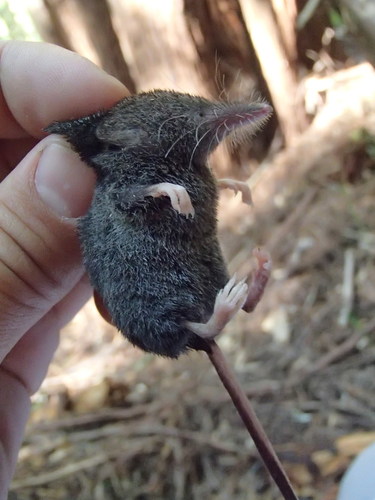
Trowbridge's Shrew
Sorex trowbridgii
A tiny powerhouse of the Pacific Northwest, Trowbridge's Shrew is a master of the forest floor. Despite its small size, this hyperactive hunter plays a massive role in balancing the insect populations of Western woodlands.
Quick Identification
Size
Total length 110–130 mm (4.3–5.1 in); weight 3–6 g (0.1–0.2 oz)
Colors
Uniform dark gray to brownish-black upperparts; distinctly lighter smoky gray underparts. Tail is sharply bicolor, dark on top and pale below.
Key Features
- Distinctly bicolor tail (dark top, white/pale bottom)
- Long, pointed snout with sensitive whiskers
- Smoky gray underparts contrasting with dark back
- Small eyes and ears mostly hidden in thick fur
When You’ll See Them
Geographic range
Where Does the Trowbridge's Shrew Live?
This elusive mammal is a native of the Pacific Northwest and the West Coast of North America. Its core range extends from the southwestern tip of British Columbia in Canada, stretching down through the moist forests of Washington and Oregon, and reaching as far south as the central coast and Sierra Nevada mountains of California. Because they thrive in the temperate rainforests of this region, they are rarely found far from the Pacific influence or high-moisture environments.
Basemap © OpenStreetMap contributors
Behavior
Trowbridge's shrews are high-energy dynamos, driven by an incredibly fast metabolism that requires them to consume nearly their own body weight in food every single day. Unlike many other shrew species that spend their entire lives in underground tunnels, these agile mammals are frequently seen scurrying across the forest floor, navigating through thick leaf litter and climbing over fallen debris with surprising speed.
They are solitary and highly territorial creatures. When two shrews encounter one another, they often engage in high-pitched squeaking matches to defend their foraging grounds. While they are technically active both day and night to satisfy their hunger, they prefer the cover of twilight or heavy overcast skies to avoid being spotted by predators like owls, hawks, and domestic cats.
EverydayEarth exclusive
Camera Tips
Capturing Trowbridge's Shrew requires a camera with a very fast trigger speed and a high-quality macro or close-focus capability. Because these shrews are only a few inches long, standard trail cameras placed high on a tree will miss them entirely. Instead, mount your camera just 3 to 5 inches off the ground, aiming parallel to a fallen log or along the edge of a rock wall. These 'corridors' are the shrew's primary highways through the leaf litter.
Use 'Burst Mode' or high-frame-rate video settings if your camera supports them. These animals move in rapid, jerky bursts of speed, and a single photo often results in a blurry tail or a snout entering the frame. If your camera allows for it, reduce the focal distance or use a 'small critter' mode. Since they are attracted to moist environments, placing the camera near a leaky outdoor faucet or a shaded birdbath with ground-level access can significantly increase your chances of a sighting.
While we don't recommend standard baiting, creating a 'micro-habitat' can lure them in. Piling up some damp leaf litter and bark near the camera's field of view creates a natural foraging spot they are likely to investigate for insects. In the winter, they are known to seek out Douglas fir seeds, so placing a few cones in front of the lens might encourage them to pause long enough for a clear shot. Keep in mind that their rapid movements can trigger your camera frequently, so check your SD card and batteries more often than you would for larger mammals.
Similar Species
Species that look similar or are commonly confused with Trowbridge's Shrew.
Frequently Asked Questions
Record Trowbridge's Shrew at your habitat
Connect a camera to start building your own species record — AI identifies every visitor automatically.