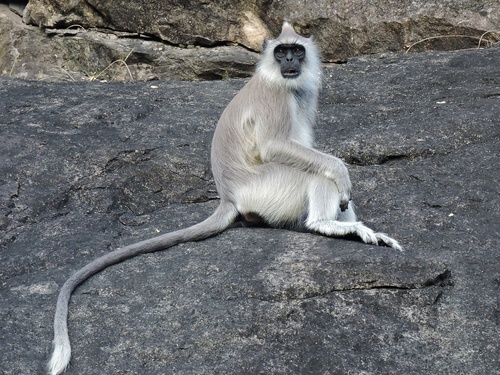
Tufted Gray Langur
Semnopithecus priam
With its silver-gray coat and iconic 'mohawk' crest, the Tufted Gray Langur is one of South Asia's most charismatic primates. Whether leaping through the canopy or patrolling temple grounds, these social 'watchmen' are a highlight for any backyard wildlife enthusiast.
Quick Identification
Size
Head-body length 50–70 cm (20–28 in); tail 70–100 cm (28–39 in); weight 11–18 kg (24–40 lbs)
Colors
Light gray to brownish-gray coat with a pale underbelly; distinctive jet-black face and ears; dark hands and feet
Key Features
- Prominent pointed tuft or crest of hair on the crown
- Extremely long, slender tail used for balance
- Black mask-like face framed by light fur
- Long, lanky limbs built for both climbing and ground movement
When You’ll See Them
Geographic range
Where Does the Tufted Gray Langur Live?
Native to the southern reaches of the Indian subcontinent, the Tufted Gray Langur is a signature species of southeast India and the island of Sri Lanka. In India, they are commonly found across the states of Andhra Pradesh, Karnataka, and Tamil Nadu, while in Sri Lanka, they occupy the dry zone lowlands. They are highly adaptable, thriving in both pristine wildlife sanctuaries and human-dominated landscapes where large trees are present.
Basemap © OpenStreetMap contributors
Behavior
Tufted Gray Langurs are highly social primates that live in organized troops ranging from 10 to over 50 individuals. These groups are typically led by a dominant male and exhibit complex social hierarchies maintained through grooming and vocalizations. While they are expertly adapted for life in the trees, they are more terrestrial than many other langur species, often seen walking gracefully on all fours across forest floors or suburban roads to move between feeding sites.
Known as the 'watchmen of the jungle,' these monkeys have an incredible symbiotic relationship with other wildlife, such as spotted deer. They possess keen eyesight and will emit loud, barking alarm calls from the canopy to warn of approaching predators like leopards or tigers. In areas near human settlements or temples, they can become quite bold and habituated, though they generally maintain a respectful distance unless encouraged with food.
EverydayEarth exclusive
Camera Tips
To capture the Tufted Gray Langur on a backyard or trail camera, placement is everything. Since these monkeys are semi-terrestrial, you should mount your camera at a medium height—roughly 4 to 5 feet off the ground—angled slightly downward toward a clear path or opening. This allows you to capture their unique 'galloping' gait as they move between trees. If you have a fruiting tree like a mango, tamarind, or neem, aim the camera at the lower branches where they often congregate to forage.
Because they travel in large troops, one langur usually means twenty more are following. Set your camera to 'Burst Mode' with a 3-photo sequence or record 15-20 second video clips. This will help you capture the fascinating social interactions, such as mothers carrying infants or juveniles playing. Use a camera with a fast trigger speed (0.3s or less), as their leaps between branches are lightning-fast and can easily result in a blurry tail if the camera is too slow.
Langurs are most active in the early morning and late afternoon when the light is golden and soft. To get the best detail on their dark, expressive faces, avoid placing the camera in direct, harsh midday sun, which can wash out their gray fur. Instead, look for dappled shade. If you are in a dry area, a simple ground-level water basin or birdbath is the ultimate 'natural' lure; they will often descend in groups to drink during the heat of the day, providing excellent eye-level footage.
Similar Species
Species that look similar or are commonly confused with Tufted Gray Langur.
Frequently Asked Questions
Record Tufted Gray Langur at your habitat
Connect a camera to start building your own species record — AI identifies every visitor automatically.