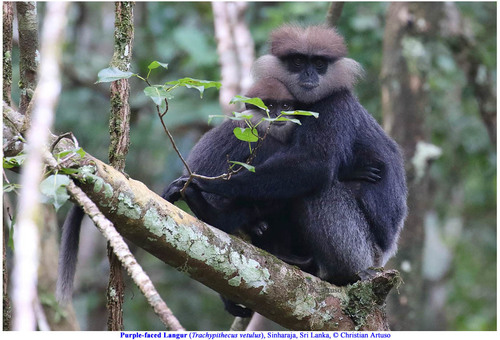
Purple-faced Langur
Semnopithecus vetulus
Sri Lanka's shy canopy acrobat, the Purple-faced Langur is an endangered leaf-monkey known for its striking white whiskers and incredible leaping ability. This elusive endemic is a prize for any backyard wildlife observer in the wet zone.
Quick Identification
Size
Head-to-body length of 45-65 cm (18-26 in) with a tail of 60-85 cm (24-33 in); weighs between 3.1-10 kg (6.8-22 lbs).
Colors
Dark brown to blackish body; dark purplish-black face; prominent grayish-white whiskers; silvery-gray rump patch in some subspecies.
Key Features
- Dark purple-tinted face framed by thick, light-colored whiskers
- Exceptionally long, non-prehensile tail
- Shy, arboreal nature, rarely descending to the ground
- Thick, shaggy coat ranging from chocolate brown to charcoal black
When You’ll See Them
Geographic range
Where Does the Purple-faced Langur Live?
This primate is an endemic treasure of Asia, found exclusively on the island of Sri Lanka. Its core range is concentrated within the island's 'wet zone' and central highlands, though distinct subspecies are scattered across the lowland dry zones where riverine forests provide enough cover. Because it is a habitat specialist limited to this single island, it is one of the most geographically restricted primates in the world.
Basemap © OpenStreetMap contributors
Behavior
The purple-faced langur is a remarkably shy and elusive primate, known for its strictly arboreal lifestyle. Unlike the more bold macaques found in the same region, these langurs prefer the safety of the high canopy and will often freeze or retreat deep into the foliage when they sense human presence. They live in small, cohesive social groups usually led by a single dominant male, and they are highly territorial, with males emitting loud, resonant barks to signal their presence to rival groups at dawn.
In suburban environments, they have adapted to 'home gardens' but remain cautious. Their movement is characterized by spectacular leaps—they can clear gaps of several meters between tree crowns with ease. Because they are folivores with a specialized digestive system, they spend a large portion of their day resting to ferment the tough leaves they consume, making them appear sedentary until it is time to move to a new feeding or sleeping site.
EverydayEarth exclusive
Camera Tips
To capture high-quality footage of the purple-faced langur, your camera must go where they live: high in the trees. These monkeys are extremely reluctant to touch the ground, so mounting your AI camera at a height of 15 to 25 feet is essential. Look for 'canopy bridges'—horizontal branches that connect the crowns of two large trees like Mango, Jackfruit, or Bo trees. Langurs use these specific pathways repeatedly, and a camera angled parallel to a popular branch will capture the best profile shots.
Because this species is famously shy, use a camera with 'No-Glow' or 940nm black infrared LEDs. Standard 'Low-Glow' red LEDs can be detected by the monkeys, potentially causing the troop to abandon that part of the garden or behave unnaturally. Avoid placing the camera in direct sunlight, as the deep shadows of the canopy combined with their dark fur can lead to poor exposure; a shaded spot with consistent ambient light is ideal for their dark coloration.
Set your trigger speed to the fastest possible setting. While langurs spend much of their time sitting still to digest, their travel is explosive. They are master leapers, and a slow trigger will result in nothing but a blurry tail in the frame. Using a video mode of at least 20 seconds is highly recommended, as it allows you to observe their grooming habits and the playful behavior of the younger 'infants,' which are often lighter in color than the adults.
In suburban settings, focus on trees that are currently fruiting or flushing with new leaves. While they are leaf-eaters, the allure of a fruiting Mango tree will often bring even the shiest troop closer to a house. Ensure the camera is secured tightly with a cable lock, as while they aren't as mischievous as macaques, their weight during a landing can shift a poorly mounted camera.
Similar Species
Species that look similar or are commonly confused with Purple-faced Langur.
Tufted Gray Langur
Lighter gray coat and lacks the prominent white side-whiskers; much more comfortable on the ground than the purple-faced variety.
Toque Macaque
Much smaller with a brownish coat and a unique cap of hair; they are bold around humans and lack the langur's specialized leaf-eating diet.
Frequently Asked Questions
Record Purple-faced Langur at your habitat
Connect a camera to start building your own species record — AI identifies every visitor automatically.