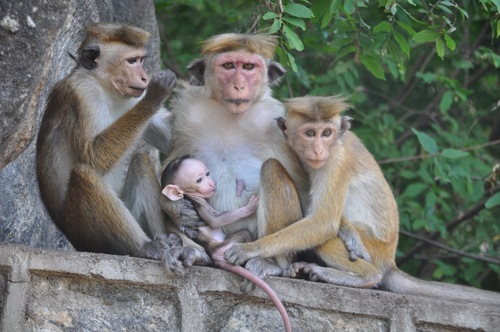
Toque Macaque
Macaca sinica
Endemic to the island of Sri Lanka, the Toque Macaque is famous for its 'toque' hairstyle and sharp intelligence. These social primates are as comfortable in ancient jungle temples as they are in suburban backyards.
Quick Identification
Size
Body length of 35-55 cm (14-22 in) with a tail of 40-60 cm (16-24 in); weight ranges from 2.5-8.4 kg (5.5-18.5 lbs).
Colors
Reddish-brown to golden-yellow upperparts with a pale, dusky-white underside; females often feature a distinct pinkish-red face as they mature.
Key Features
- Distinctive radiating whorl of hair on the crown resembling a cap
- Tail is typically longer than the head and body combined
- Amber-colored eyes with expressive, light-colored eyelids
- Slender, agile build adapted for both trees and ground.
When You’ll See Them
Geographic range
Where Does the Toque Macaque Live?
The Toque Macaque is an island endemic native to the tropical region of South Asia, specifically the island nation of Sri Lanka. They are found across nearly every province of the country, ranging from the arid northern plains to the lush central highlands. Because they are restricted to this single island, they have no native populations anywhere else in the world, though they are divided into three distinct subspecies based on the specific climatic zones of the island.
Basemap © OpenStreetMap contributors
Behavior
During the day, they are active foragers, splitting their time between the safety of the canopy and the forest floor. They are remarkably intelligent and have learned to thrive alongside humans, frequently inhabiting ancient temple sites and suburban gardens. While they can be bold and mischievous when searching for food, they remain wary of predators like leopards and large pythons, using a specific set of alarm calls to warn the troop of danger.
Their reproductive behavior is seasonal in some regions, and the troop's social dynamic changes during these times as males compete for status. Despite their proximity to humans, they maintain a rich repertoire of natural behaviors, including swimming for leisure or escape and using complex facial expressions to communicate dominance or submission.
EverydayEarth exclusive
Camera Tips
Attracting them to a specific spot is best done using natural lures like fruiting trees (especially mango, jackfruit, or ficus) or a consistent water source. In the dry zones of Sri Lanka, a simple garden birdbath or shallow water feature is an irresistible magnet for an entire troop. However, be extremely careful with camera security; these primates are highly curious and have dexterous hands. Use a protective metal security box and ensure the camera is strapped tightly to a sturdy tree to prevent them from tilting the lens or trying to pull the device off the mount.
For the best footage, use a fast trigger speed (under 0.5 seconds) because macaques move with sudden, jerky motions. Setting your camera to 'Hybrid Mode' (capturing both a photo and a short video) is ideal for this species. The photos provide clear identification of individuals through their unique facial features, while the video captures their fascinating social interactions, such as nursing, play-fighting, or vocalizing.
Be mindful of the lighting in dense tropical environments. If your camera is placed under a thick canopy, ensure it has a high-quality sensor for low-light conditions to avoid grainy footage. The best 'action' shots usually occur in the early morning or late afternoon when the troop is most active and the sunlight is soft enough to highlight the golden tones of their fur without causing harsh glares on their pale faces.
Similar Species
Species that look similar or are commonly confused with Toque Macaque.
Tufted Gray Langur
Much larger with silver-gray fur and a black face; lacks the distinctive hair whorl on the crown.
Purple-faced Langur
Darker, almost black fur with prominent white whiskers; almost entirely arboreal compared to the more ground-dwelling macaque.
Rhesus Macaque
Found in mainland India, not Sri Lanka; lacks the radiating hair whorl and has a shorter tail.
Frequently Asked Questions
Record Toque Macaque at your habitat
Connect a camera to start building your own species record — AI identifies every visitor automatically.