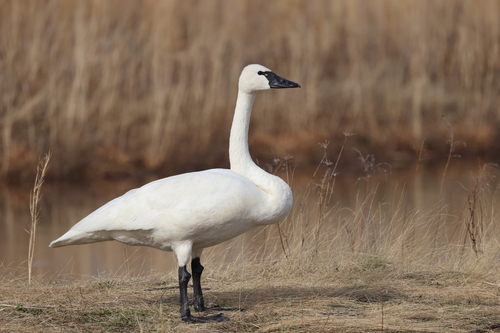
Tundra Swan
Cygnus columbianus
The Tundra Swan is a majestic Arctic traveler that brings a touch of wild elegance to winter wetlands. Watch for their snowy white plumage and listen for their haunting, musical calls as they gather in social flocks.
Quick Identification
Size
Length: 115–150 cm (45–59 in); Wingspan: 168–211 cm (66–83 in); Weight: 3.4–9.6 kg (7.5–21 lbs)
Colors
Adults are entirely white; bill is black, usually with a small yellow spot near the eye; legs and feet are black. Juveniles are gray-brown with pinkish-black bills.
Key Features
- Small yellow spot at the base of the bill near the eye
- Rounded 'U' shape where forehead feathers meet the bill
- High-pitched barking or whistling call
- Smaller and shorter-necked than the Trumpeter Swan
When You’ll See Them
Sightings on EverydayEarth
Apr 13, 2026
Several large white birds fly low across the Mississippi River. They appear in small groups, moving steadily over the water. The surrounding valley is filled with dormant, brown vegetation and leafless trees typical of early spring in the region.
Behavior
Tundra Swans are highly social and vocal birds, especially during their winter residency in temperate regions. Known for their powerful 'whistling' or 'barking' calls, they travel in large family groups and flocks that can number in the hundreds. During the day, they move between roosting sites on open water and feeding sites in nearby fields or shallow wetlands. Unlike the more sedentary Mute Swan, the Tundra Swan is a champion migrant, traveling thousands of miles from the Arctic circle to coastal estuaries each year.
While they are wary of humans and will take flight if approached too closely, they have become increasingly common in agricultural landscapes. They spend much of their time tipping forward in the water to reach submerged plants or walking through harvested fields. Within the flock, family bonds are strong; young 'cygnets' stay with their parents through their first entire migration cycle, learning the traditional stopover points and wintering grounds.
EverydayEarth exclusive
Camera Tips
Capturing Tundra Swans on a trail camera requires a strategic approach to water and light. Because these birds prefer wide-open spaces to keep an eye out for predators, your camera should be positioned on the edge of a wetland or a flooded field. Use a sturdy T-post or a weighted tripod if no trees are available. Aim the camera at a height of about 2 to 3 feet, slightly tilted downward to capture the swan's behavior while it's foraging on the ground or in the shallows. If you are near water, ensure your camera housing is waterproof and check for condensation on the lens, which is common in the damp environments these birds inhabit.
White birds are notoriously difficult to photograph without 'blowing out' the highlights. To avoid seeing just a white blob on your screen, try to position the camera so the sun is at the camera's back during peak activity hours, or look for spots with soft, indirect morning light. If your camera allows for exposure adjustment, set it to -1.0 EV to preserve the detail in their white feathers. Using a high-speed trigger or a multi-shot 'burst' mode is essential, as Tundra Swans are frequently in motion—whether they are preening, social-signaling with wing flaps, or preparing for a dramatic water-skimming takeoff.
In agricultural settings, swan activity is dictated by the availability of food. Look for 'hot spots' in corn or wheat fields where you see white feathers or large amounts of swan droppings. Placing your camera near the transition zone between the water where they sleep and the fields where they eat will yield the best results. Since they are sensitive to new objects in their environment, try to camouflage your camera with local grasses or stalks. Time-lapse mode can be a secret weapon here; set it to take a photo every 5 to 10 minutes during the day to track the movement of the entire flock across a field, which video or motion triggers might miss if the birds are stationary for long periods.
Similar Species
Species that look similar or are commonly confused with Tundra Swan.
Frequently Asked Questions
Record Tundra Swan at your habitat
Connect a camera to start building your own species record — AI identifies every visitor automatically.