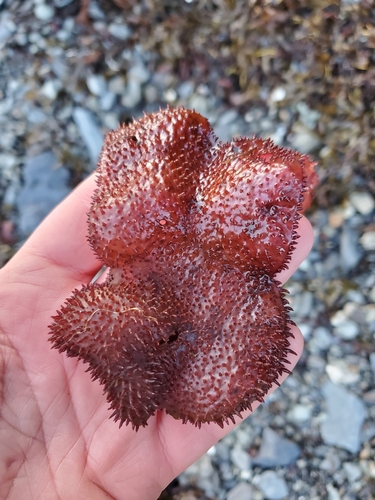
Turkish Towel
Chondracanthus exasperatus
Meet the Pacific's most luxurious seaweed, known for its thick, 'towellike' texture and vibrant maroon hues. A cornerstone of the tide pool community, the Turkish Towel is as resilient as it is beautiful.
Quick Identification
Size
Blades typically range from 30 to 80 cm (12 to 32 inches) in length and 10 to 30 cm (4 to 12 inches) in width.
Colors
Deep reddish-purple, maroon, or dark brown; can bleach to yellow or pale pink in high sunlight.
Key Features
- Broad, thick blades with a rubbery feel
- Surface densely covered in tiny, pointed bumps called papillae
- Lacks a distinct midrib or central vein
- Small, disc-like holdfast at the base
When You’ll See Them
Behavior
Turkish Towel is a perennial red seaweed that anchors itself firmly to rocks in the lower intertidal and subtidal zones. While it doesn't 'behave' in the sense of an animal, it is highly reactive to its environment. During high tide, its thick, heavy blades sway gracefully with the surge, absorbing nutrients and sunlight. At low tide, it often lies flat against wet rocks, where its bumpy texture helps it trap a thin layer of moisture, preventing the plant from drying out before the water returns.
As a foundational member of the Pacific coastal ecosystem, Turkish Towel acts as a living habitat. Its dense, textured blades provide a perfect nursery and hiding spot for small crustaceans, snails, and juvenile fish. Interestingly, the very texture that gives it its name—those thousands of tiny papillae—actually makes it difficult for heat to escape, which can confuse infrared sensors, a unique challenge for modern wildlife technology.
EverydayEarth exclusive
Camera Tips
Capturing the Turkish Towel requires a specialized approach since it lives in the 'splash zone.' To get high-quality images or AI detections, use a waterproof action camera or a trail cam with an IP68 rating. Secure the camera to a stable rock or a weighted tripod during low tide. The best angle is a low, side-on perspective (about 45 degrees) rather than top-down. This allows the camera to capture the three-dimensional 'towel' texture of the papillae, which is the key diagnostic feature for AI identification.
Lighting is crucial for marine flora. Because Turkish Towel is a dark reddish-purple, it can appear as a black blob in poor light. Aim for 'Golden Hour' timing during a low tide; the low sun angle creates shadows behind each tiny bump on the blade, making the texture pop. If you are using an AI-powered camera with infrared capabilities, be aware that the bumpy surface of Chondracanthus exasperatus can scatter IR light differently than smooth kelp, sometimes appearing 'fuzzier' on night-vision sensors. High-contrast settings will help the AI distinguish the blade edges from the dark, wet rocks.
Don't just look for the seaweed itself—use it as a focal point for 'intertidal theater.' Set your camera to a time-lapse mode (one photo every 30-60 seconds) over a four-hour window as the tide comes in. You will capture the dramatic transition as the Turkish Towel 'wakes up' and begins to float, often revealing crabs and small fish that were hiding underneath it. To keep your lens clear, apply a thin coat of rain-repellent solution to the outer housing to prevent salt crust and water droplets from obscuring the view.
Similar Species
Species that look similar or are commonly confused with Turkish Towel.
Frequently Asked Questions
Record Turkish Towel at your habitat
Connect a camera to start building your own species record — AI identifies every visitor automatically.