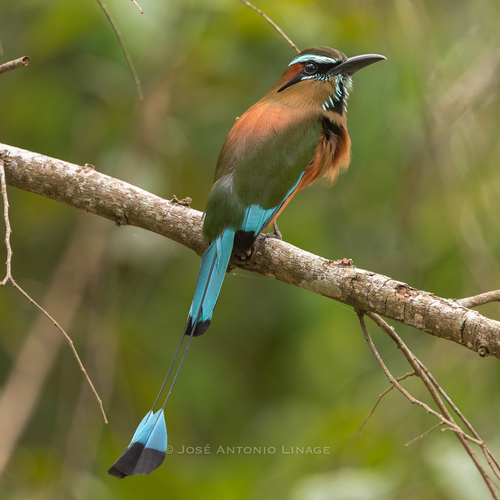
Turquoise-browed Motmot
Eumomota superciliosa
The 'Torogoz' of Central America is a living jewel, famous for its incredible racket-tipped tail and glowing turquoise eyebrows. A bold garden visitor, this bird is as much an acrobat as it is a master of the sit-and-wait hunt.
Quick Identification
Size
34 cm (13.5 in) in length including tail; weight ranges from 60–70g (2.1–2.5 oz)
Colors
Olive-green body with a bright rufous (cinnamon) back and belly; distinctive turquoise-blue stripe above the eye; black facial mask; tail feathers are tipped with blue and black 'rackets'
Key Features
- Two long tail feathers with bare shafts and racket-shaped tips
- Broad, vibrant turquoise-blue stripe over each eye
- Black triangular mask across the face
- Frequent 'pendulum' tail-wagging motion
When You’ll See Them
Behavior
The Turquoise-browed Motmot is surprisingly bold compared to its shier forest-dwelling relatives. It is frequently seen in open areas, perching conspicuously on utility lines, fences, and low tree branches. From these vantage points, it performs its most famous behavior: swinging its long tail back and forth like a clock pendulum. While many believe this is a mating display, it is actually a communication tool used to tell potential predators that the bird has spotted them and that a pursuit would be futile.
These birds are generally solitary or found in pairs. They are sit-and-wait hunters that remain motionless for long periods before suddenly darting down to the ground or into the air to snatch prey. During the breeding season, they become more social, often nesting in small colonies where they excavate long, winding tunnels into the sides of earth banks, limestone quarries, or even the walls of ancient ruins.
EverydayEarth exclusive
Camera Tips
To capture the Turquoise-browed Motmot on your backyard camera, focus on their perching preferences. Unlike shy deep-forest birds, these motmots love 'edge' environments. Position your camera to face a prominent, horizontal branch or a fence rail that has a clear view of an open lawn or garden patch. Because they are perch-and-pounce hunters, they will return to the same spot repeatedly if it offers a good view of potential prey on the ground. Set your camera at a height of 4 to 7 feet for the best eye-level portraits.
While they won't visit a standard seed feeder, you can successfully lure them with water. A solar-powered birdbath or a fountain with moving water is highly effective. These birds enjoy a deep soak, and a camera positioned near a water source will often catch them mid-splash or preening their elaborate tail feathers afterward. If you have an earth bank on your property, keep an eye out for 3-inch diameter circular holes—these are potential nesting sites. Placing a camera 15 feet away from a nest entrance can provide incredible footage of them bringing large insects to their chicks, though you must be careful never to block the entrance or disturb the soil.
For technical settings, prioritize a high shutter speed. The motmot's 'pendulum' tail wag is a fast motion that can blur in low light. If your camera allows for scheduled recording, focus on the first three hours after sunrise when the light hits their iridescent turquoise brows, making them glow against the green foliage. In suburban settings, they are remarkably tolerant of human activity, so don't be afraid to place your camera near well-traveled garden paths where insects are plentiful.
Similar Species
Species that look similar or are commonly confused with Turquoise-browed Motmot.
Frequently Asked Questions
Record Turquoise-browed Motmot at your habitat
Connect a camera to start building your own species record — AI identifies every visitor automatically.