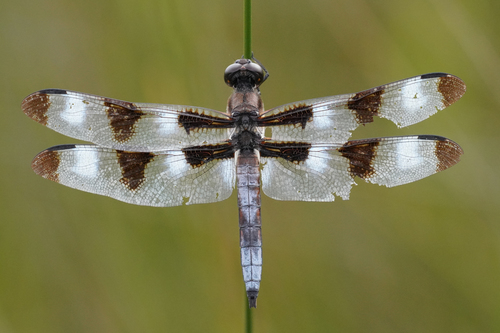
Twelve-spotted Skimmer
Libellula pulchella
A master of aerial maneuvers, the Twelve-spotted Skimmer is easily recognized by its ornate, spotted wings and bold territorial displays. This common yet striking dragonfly is a welcome guest in any backyard pond, serving as a natural form of pest control.
Quick Identification
Size
Length: 2.0–2.3 inches (50–58 mm); Wingspan: 3.1–3.5 inches (80–90 mm)
Colors
Brownish body with yellow side-stripes; wings feature three black spots each (twelve total). Mature males have white patches between wing spots and a powdery blue abdomen.
Key Features
- Three distinct dark spots on each wing
- Bright white patches between wing spots (males only)
- Pale blue 'pruinose' abdomen on mature males
- Yellowish-brown stripes along the sides of the thorax
When You’ll See Them
Behavior
The Twelve-spotted Skimmer is a quintessential 'percher' dragonfly. Unlike some species that fly continuously, this skimmer spends a significant portion of its day resting on tall grasses, twigs, or reeds near the water's edge. From these vantage points, it scans the sky for prey or rival males. When a target is spotted, it launches into a powerful, darting flight, often returning to the exact same perch moments later.
Males are highly territorial and will aggressively patrol a specific section of a pond or marsh shoreline. They are known for their 'hover-and-dart' flight style, where they remain stationary in mid-air before accelerating with incredible speed to chase off intruders. While they are bold and active during the hottest parts of the day, they are not particularly social and usually maintain a respectful distance from other skimmers unless engaged in a territorial dispute.
EverydayEarth exclusive
Camera Tips
To capture the best footage of a Twelve-spotted Skimmer, you must capitalize on their habit of returning to the same 'home base.' Look for a prominent, vertical stick, reed, or tall piece of garden art near water. Once you see a dragonfly land there once, it is highly likely to return. Place your camera on a tripod or mount it at the same height as the tip of the perch, roughly 2 to 4 feet away. This 'pre-focusing' on a known landing spot is far more effective than trying to track them in flight.
Because these insects are most active in bright, direct sunlight, you will have plenty of light to work with, but you must be wary of silhouettes. Position your camera so the sun is behind it, illuminating the intricate patterns of the wings and the powdery blue of the male's abdomen. If your camera has a 'burst' or 'high-speed' mode, use it. These dragonflies take off and land in the blink of an eye, and a high frame rate is the only way to catch the moment their wings unfurl.
If you are using a motion-activated camera, set the sensitivity to high and the trigger interval to zero. Dragonflies move incredibly fast, and even a half-second delay can result in a photo of an empty stick. For the best results, use a camera with a macro lens or a close-focusing capability. Since you cannot bait dragonflies with food, 'bait' them with habitat—adding a few tall, dry bamboo stakes to a sunny birdbath or pond edge will create an irresistible landing zone for your lens.
Similar Species
Species that look similar or are commonly confused with Twelve-spotted Skimmer.
Common Whitetail
The Whitetail has a single broad dark band on each wing and a shorter, thicker white abdomen.
Eight-spotted Skimmer
Found mostly in the West, it has only two dark spots per wing instead of three.
Painted Skimmer
Features amber-colored wings with smaller, less distinct spots and a yellowish body.
Frequently Asked Questions
Record Twelve-spotted Skimmer at your habitat
Connect a camera to start building your own species record — AI identifies every visitor automatically.