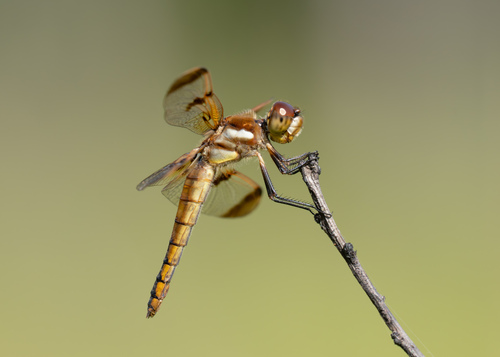
Painted Skimmer
Libellula semifasciata
A masterpiece of the marsh, the Painted Skimmer stands out with its glowing amber wings and intricate markings. As one of the first dragonflies to herald the spring, it brings a splash of golden-orange to backyard ponds and woodland edges.
Quick Identification
Size
Length: 35–46 mm (1.4–1.8 in); Wingspan: 70–80 mm (2.7–3.1 in)
Colors
Golden-orange to brownish body with amber-tinted wings; wings feature three distinct dark brown spots at the base, middle (node), and tip (apex).
Key Features
- Three dark spots on each wing
- Amber-washed wing membranes
- Golden-orange abdomen with a dark central stripe
- Two pale diagonal stripes on the thorax
When You’ll See Them
Behavior
The Painted Skimmer is a sentinel of the early spring, often being one of the first dragonfly species to emerge as the weather warms. Unlike many of its cousins that spend their time patrolling long distances over open water, this species is a 'percher.' It spends a significant portion of its day resting on the tips of tall grasses, shrubs, or twigs, using these vantage points to scan the horizon for both prey and potential mates.
When a Painted Skimmer spots a meal, it launches into a sudden, erratic flight, snatching the insect out of the air with its legs before returning to its perch to eat. They are notably more tolerant of shade than many other skimmers, frequently seen in sun-dappled forest edges or woodland clearings where they find shelter from the wind. Their flight is strong but often involves short bursts rather than sustained soaring.
EverydayEarth exclusive
Camera Tips
To capture the Painted Skimmer on camera, you must focus on their preferred 'hunting stations.' These dragonflies are remarkably consistent, often returning to the exact same vertical twig or grass seed-head dozens of times an hour. Identify a prominent reed or a garden stake near a water source and set your camera to focus specifically on that point. A tripod is essential here; position your camera at eye-level with the top of the vegetation, usually 2 to 4 feet off the ground.
Lighting is the secret to making this species look spectacular. Because their wings are naturally tinted with amber, backlighting—where the sun is behind the dragonfly and facing the camera—will make the wings appear to glow like stained glass. Early morning (8-10 AM) is the best time for this, as the insects are often less flighty while they wait for the sun to warm their bodies. Use a high shutter speed (at least 1/1000s) if your camera allows it, as this will freeze the intricate patterns of their wing veins if they decide to take off during the shot.
If you are using an AI-powered backyard camera, look for a 'macro' or 'close-focus' setting. Since dragonflies are small, you want to be as close as the camera's minimum focus distance allows—usually between 1.5 to 3 feet. You can 'bait' your camera site not with food, but with architecture. Stick a few bamboo skewers or tall, thin sticks into a sunny patch of your garden near a pond or birdbath. The Painted Skimmer will find these perches irresistible, providing you with a predictable stage for your photos.
Similar Species
Species that look similar or are commonly confused with Painted Skimmer.
Twelve-spotted Skimmer
Lacks the amber wing tint and has much larger, more distinct alternating black and white spots.
Four-spotted Skimmer
Smaller with olive-brown coloring and fewer spots, lacking the vibrant orange abdomen of the Painted Skimmer.
Halloween Pennant
Has much more extensive orange and black banding on the wings, making them look like tiny flags in the wind.
Frequently Asked Questions
Record Painted Skimmer at your habitat
Connect a camera to start building your own species record — AI identifies every visitor automatically.