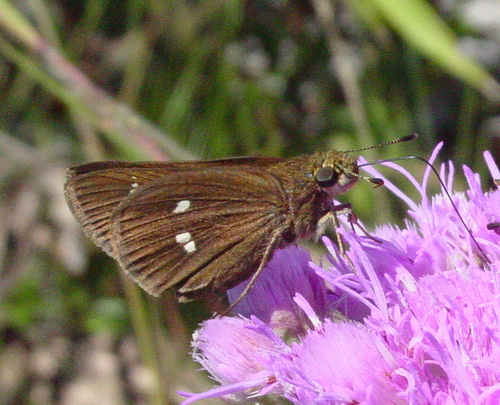
Twin-spot Skipper
Oligoria maculata
A small but striking resident of the Southeast, the Twin-spot Skipper is easily identified by the bright white dots that decorate its dark, velvety wings. This agile flyer is a frequent visitor to sun-drenched gardens and damp meadows.
Quick Identification
Size
Wingspan of 3.2 to 3.8 cm (1.25 to 1.5 inches)
Colors
Dark chocolate brown wings with small translucent white spots on the forewings and three distinct white spots on the underside of the hindwings.
Key Features
- Dark brown base color with a purplish sheen on the wing undersides
- Three prominent white spots arranged in a row on the underside of the hindwing
- Large, dark eyes and a robust, furry body
- Fast, darting flight pattern characteristic of the Hesperiidae family
When You’ll See Them
Behavior
The Twin-spot Skipper is a fast-moving, energetic butterfly known for its erratic and powerful flight. Like many members of the 'grass skipper' subfamily, it often perches in a unique 'jet-plane' position, where its hindwings are spread flat while its forewings are held partially upright. This posture is thought to help the insect maximize heat absorption from the sun while remaining ready for a quick takeoff.
These butterflies are relatively solitary and are most often seen darting between low-lying nectar sources or patrolling the edges of wooded areas. While they can be wary of movement, they become quite focused while feeding, allowing patient observers to get a close look at their intricate markings. They are highly territorial over prime nectar spots and will often chase away other small insects that intrude on their favored blossoms.
EverydayEarth exclusive
Camera Tips
To successfully capture the Twin-spot Skipper on a backyard camera, you need to focus on 'micro-habitats' within your garden. Place your camera on a short tripod or ground mount, as these butterflies spend the majority of their time less than two feet off the ground. Aim the lens toward a cluster of nectar-rich flowers like Lantana or Mistflower. Because the Twin-spot is small and moves quickly, setting your camera to a high-speed trigger or a 10-second video burst mode is essential to catch them as they land to feed.
Lighting is a critical factor for this species. They are most active in patches of bright, direct sunlight where they can bask to maintain their body temperature. Position your camera so the sun is at its back, illuminating the underside of the wings where the diagnostic white spots are located. Avoid high-traffic areas where shadows might frequently cross the sensor, as these skippers are sensitive to sudden changes in light and will dart away at the slightest flicker.
To increase your chances of a sighting, create a 'puddling station' near your nectar plants. This is simply a shallow dish filled with sand and kept damp with a little water; butterflies use these spots to drink minerals from the soil. Placing a camera near a puddling station often results in longer, more stable footage than at a flower, as the butterfly will remain stationary for several minutes while it sips. Ensure your camera is set to its macro or close-up focus range—typically 12 to 18 inches—to get a clear shot of the white spots that give this species its name.
Similar Species
Species that look similar or are commonly confused with Twin-spot Skipper.
Frequently Asked Questions
Record Twin-spot Skipper at your habitat
Connect a camera to start building your own species record — AI identifies every visitor automatically.