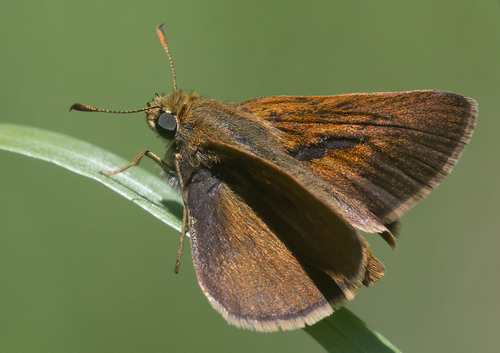
Dun Skipper
Euphyes vestris
A subtle yet charming visitor to summer meadows, the Dun Skipper is a master of camouflage with its dark, earthy tones and lightning-fast flight. Often overlooked for flashier species, this 'sedge witch' reveals hidden beauty to those who look closely at the damp edges of their backyard.
Quick Identification
Size
Wingspan of 2.9 to 3.5 cm (1.1 to 1.4 inches)
Colors
Uniform dark chocolate brown; males have a thin black scent patch (stigma); females feature two small, translucent white dots on the forewing.
Key Features
- Hooked antennae (apiculi) characteristic of skippers
- Distinctive 'fighter jet' wing posture when resting
- Lacks the bright orange or yellow patches common in other skippers
- Golden-yellow hairs often visible on the head and thorax
When You’ll See Them
Geographic range
Where Does the Dun Skipper Live?
Native to North America, the Dun Skipper enjoys a vast distribution that spans from the Atlantic coast of Nova Scotia all the way west to southern Alberta. Its core range covers the eastern half of the United States down to the Gulf Coast and eastern Texas, though it also thrives in disjunct pockets throughout the Rocky Mountains and the Pacific Northwest. Because it relies heavily on sedges for its larval stage, its presence is usually tied to regions with consistent moisture or riparian corridors.
Basemap © OpenStreetMap contributors
Behavior
The Dun Skipper, often nicknamed the 'Sedge Witch,' is known for its erratic and incredibly fast flight patterns. Unlike larger, gliding butterflies, this species 'skips' through the air with a rapid wingbeat that makes it a challenge to track with the naked eye. They are highly heliophilic, meaning they are most active during the brightest, hottest parts of the day when they can be seen darting between sunlit perches.
Males are notably territorial and are frequently seen 'perching' on tall blades of grass or sedge. They use these vantage points to monitor for potential mates, darting out aggressively to investigate any passing insect—even those much larger than themselves—before returning to their favorite lookout spot. They are generally solitary but can congregate in small groups where high-quality nectar sources like milkweed or vetch are abundant.
EverydayEarth exclusive
Camera Tips
Capturing the Dun Skipper on camera requires a strategy focused on their favorite 'landing pads.' Because they are small and dark, they often blend into the shadows of dense foliage. Position your AI-powered camera within 12 to 24 inches of purple or pink nectar plants like Joe-Pye Weed, Pickerelweed, or Red Clover. These butterflies are particularly attracted to the color purple, which also provides a high-contrast background that helps the camera's autofocus lock onto the dark insect.
Set your camera to a high shutter speed or a 'burst' photo mode. Dun Skippers are famous for their sudden, jerky movements; a standard trigger might only capture a blur as they take off. If your camera allows for manual focus zones, target the top of flat-topped flowers where they spend the most time probing for nectar. Using a camera with macro capabilities is essential to distinguish the subtle 'stigma' on the male's wing or the two tiny dots on the female that separate them from other 'little brown jobs' of the butterfly world.
If you aren't seeing them at your flowers, move your camera to the edge of a pond or a damp drainage ditch where sedges (Carex) are growing. This is where the 'Sedge Witch' earns its name. Look for the males perching on the very tips of the vegetation. For the best lighting, ensure your camera is positioned so the sun is behind it; this will illuminate the golden-yellow hairs on the skipper's head and thorax, which can otherwise look plain black in the shade.
Similar Species
Species that look similar or are commonly confused with Dun Skipper.
Frequently Asked Questions
Record Dun Skipper at your habitat
Connect a camera to start building your own species record — AI identifies every visitor automatically.