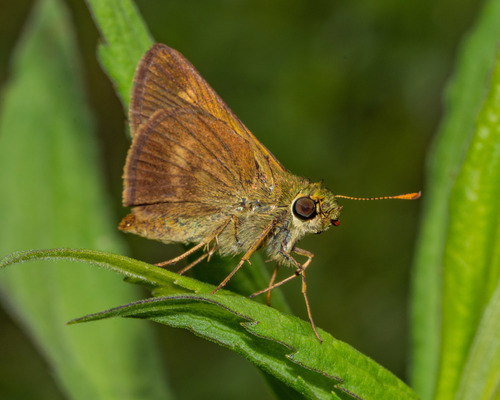
Northern Broken-Dash
Polites egeremet
The Northern Broken-Dash is a zippy, olive-brown skipper that brings a touch of subtle elegance to summer meadows. Look for their characteristic darting flight and 'broken' wing markings near your favorite garden blooms.
Quick Identification
Size
Wingspan of 2.5–3.8 cm (1.0–1.5 inches)
Colors
Dull olive-brown to dark chocolate brown; males feature a black 'broken' stigma on the forewing, while females have small, pale yellowish spots.
Key Features
- Broken black scent scale (stigma) on male forewings
- Brassy or olive-greenish sheen on the underside of wings
- Small, pale spots forming a triangle on female forewings
- Stubby, 'skipper' body shape with large eyes
When You’ll See Them
Behavior
The Northern Broken-Dash is a member of the Hesperiidae family, commonly known as 'skippers' due to their rapid, darting flight patterns. Unlike many of the more flamboyant butterflies, this species is a master of subtlety, often blending into the shadows of forest edges or the textures of tall grasses. They are primarily solitary, though you may find several congregating around a particularly rich nectar source like milkweed or dogbane.
Males are known for their territorial perching behavior. They choose prominent leaves or grass stalks in sunny patches and wait for females to pass by. If a rival male enters their territory, they engage in a high-speed aerial chase that is often too fast for the human eye to follow clearly. They are sun-lovers and will frequently bask with their wings partially open in a characteristic 'V' shape to soak up heat for flight.
EverydayEarth exclusive
Camera Tips
To successfully capture the Northern Broken-Dash on a backyard or trail camera, you must focus on 'macro' placement. Because these skippers are small and blend into their surroundings, your camera should be positioned no more than 12 to 18 inches away from target nectar plants. Flowers like Purple Coneflower, Blazing Star, or Butterfly Milkweed are ideal 'stages' for your camera. Angling the camera slightly downward will help capture the diagnostic 'broken dash' marking on the upper side of the wings.
Since skippers are attracted to mineral-rich moisture, a 'puddling station' is an excellent lure. Place a shallow tray of damp sand mixed with a tiny pinch of sea salt or compost in a sunny spot. Position your camera at ground level, facing the tray. This provides a stable, predictable location for the camera's AI to trigger, as the butterflies will remain stationary for several minutes while drinking, allowing for much sharper images than those taken mid-flight.
Lighting is your best friend when photographing this species. Their dark brown and olive tones can easily look like a 'blob' in poor light. Place your camera in an area that receives direct, bright sunlight between 11 AM and 2 PM. High-shutter speed settings are essential if your camera allows them; skippers move their wings incredibly fast, and a standard trail cam may produce motion blur without adequate light and speed.
Consider the background of your shot to ensure the butterfly 'pops.' Setting your camera up near a patch of bright green grass or colorful flowers will provide the necessary contrast for the AI to recognize the insect and for you to appreciate the subtle brassy sheen of its wings. In the peak of summer (July), try placing cameras near the transition zone between a mowed lawn and a wilder, taller grass area, as this is where they are most likely to emerge from their larval host plants.
Similar Species
Species that look similar or are commonly confused with Northern Broken-Dash.
Little Glassywing
Darker, almost black wings with a very distinct, translucent white square spot on the forewing.
Dun Skipper
Lacks the 'broken' stigma in males and is generally a uniform dark brown with no prominent light spots on the wings.
Crossline Skipper
Very similar but typically has a more orange or tawny tint to the wings compared to the olive-brown of the Broken-Dash.
Frequently Asked Questions
Record Northern Broken-Dash at your habitat
Connect a camera to start building your own species record — AI identifies every visitor automatically.