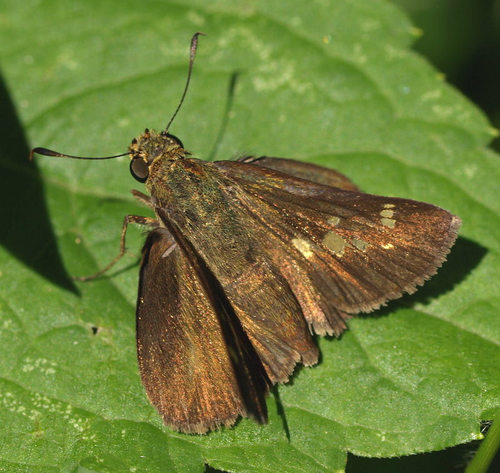
Little Glassywing
Vernia verna
The Little Glassywing is a dark, dashing inhabitant of summer meadows, named for the shimmering 'windows' on its wings. This high-speed skipper is a master of the garden, darting with precision between the season's brightest blooms.
Quick Identification
Size
Wingspan of 1 to 1.5 inches (25 to 38 mm)
Colors
Dark chocolate brown to charcoal black; features distinctive translucent, glassy white spots on the forewings. Males have a dark, felt-like scent patch (stigma) on the forewing.
Key Features
- Prominent rectangular translucent spot on the forewing
- Overall sooty-brown or blackish coloration
- Rapid, darting flight pattern
- Hooked tips on the antennae clubs
When You’ll See Them
Behavior
The Little Glassywing is a member of the skipper family, a group of butterflies known for their muscular bodies and incredibly fast, erratic flight patterns. Unlike the graceful, sailing flight of a Monarch, the Little Glassywing moves in quick, 'skipping' bursts that can make it a challenge to track. They are highly active during the heat of the day, darting between nectar sources with high energy.
Males are notably territorial and use a 'perch-and-wait' strategy to find mates. They typically select a sunny leaf or a tall blade of grass about three to four feet off the ground, scanning the area for passing females. If another male enters their airspace, they will engage in a dizzying aerial chase to defend their spot. They are generally solitary except when congregating around high-value nectar sources or damp soil.
EverydayEarth exclusive
Camera Tips
To successfully capture a Little Glassywing on your backyard camera, you need to focus on 'landing zones' rather than movement paths. These butterflies are too fast to trigger most cameras mid-flight. Instead, mount your camera on a tripod or stake and aim it directly at a cluster of their favorite nectar plants, such as milkweed or Joe-Pye weed. Keep the lens within 12 to 24 inches of the blooms to ensure the AI can resolve the specific 'glassy' spot that identifies this species.
Lighting is your best friend when photographing this butterfly. Because their signature spots are translucent, positioning your camera so the sun is behind the butterfly (backlighting) can cause those spots to 'glow,' making for a spectacular image. Use a high shutter speed setting if your camera allows it—at least 1/1000th of a second—to freeze the vibration of their wings while they feed. If you are using a trail camera, look for a 'macro' or 'close-focus' setting to avoid blurry images at short distances.
Another excellent strategy is to create a 'puddling' station. Butterflies like the Little Glassywing often land on damp soil or mud to sip minerals. Place a shallow dish filled with sand and kept moist with a bit of salt or compost in a sunny spot. Set your camera at ground level, angled slightly upward. This not only provides a stable subject for your camera's AI to track but also offers a unique perspective that shows off the butterfly's underwing markings and proboscis.
Similar Species
Species that look similar or are commonly confused with Little Glassywing.
Frequently Asked Questions
Record Little Glassywing at your habitat
Connect a camera to start building your own species record — AI identifies every visitor automatically.