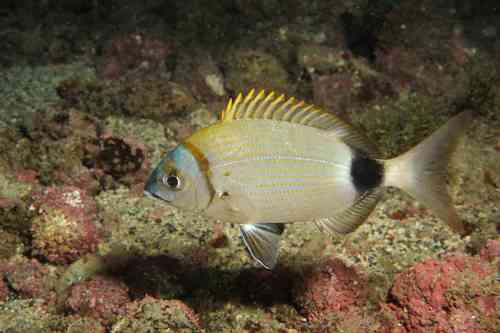
Two-banded Seabream
Diplodus prayensis
The Two-banded Seabream is a shimmering, striped jewel found only in the crystal-clear waters of Cape Verde. Its bold black bands and curious nature make it a favorite for underwater observers and marine photographers alike.
Quick Identification
Size
Typically 15–20 cm (6–8 inches) in length, with a maximum recorded size of about 25 cm (10 inches).
Colors
Silvery-gray or leaden body with two prominent vertical black bands. The first band is behind the head, and the second is at the base of the tail.
Key Features
- Two distinct vertical black bands
- Deep, oval-shaped silver body
- Small mouth with prominent front teeth
- Dark spot at the base of the pectoral fins
When You’ll See Them
Geographic range
Where Does the Two-banded Seabream Live?
This marine species is found exclusively in the Atlantic Ocean, native only to the coastal waters of the Cape Verde Islands. As a highly localized endemic, the Two-banded Seabream does not naturally occur in any other region of the world, making it a signature inhabitant of this specific Macaronesian archipelago. It is most commonly found in the shallow, nutrient-rich reef systems surrounding all the major islands in the chain.
Basemap © OpenStreetMap contributors
Behavior
The Two-banded Seabream is a social and active species often found in small schools ranging from half a dozen to twenty individuals. They are primarily diurnal, meaning they are most active during daylight hours when they forage along the seabed. These fish are known for their curiosity; they often approach divers and snorkelers, though they maintain a safe distance and can dart away quickly if startled by sudden movements.
As opportunistic feeders, they exhibit a high degree of adaptability. They are frequently seen hovering over rocky substrates, using their specialized teeth to pick at small organisms. In the turbulent waters of the Cape Verde surf zone, they show remarkable agility, effortlessly navigating the heavy swell and breaking waves that would toss smaller fish against the rocks.
EverydayEarth exclusive
Camera Tips
Capturing the Two-banded Seabream requires a specialized underwater setup, as this is a marine species. For enthusiasts with a 'backyard' ocean view in Cape Verde, an underwater action camera (like a GoPro or a Seawolf) mounted to a weighted dive plate is the most effective tool. Place the camera near rocky crevices or at the edge of a reef where the fish naturally congregate to feed. Avoid placing the camera directly in high-surge areas where bubbles might obscure the lens.
To attract a school of Two-banded Seabream into your frame, you can use a technique called 'chumming.' Place a small amount of crushed shellfish or a sea urchin inside a mesh bag and anchor it approximately one meter in front of the camera lens. This will create a natural feeding frenzy, allowing you to capture close-up details of their striped markings and social interactions. Because they are active during the day, ensure your camera is positioned so the sun is behind it to illuminate the fish's silvery scales without causing lens flare.
Set your camera to a high frame rate, such as 60 or 120 fps, to account for the fast-darting nature of these fish and the movement of the water. If you are recording in depths greater than 3 meters, consider using a red filter on your lens to counteract the blue color cast of the water and bring out the leaden-gray and black tones of the fish. Always ensure your waterproof seals are clean and lubricated before deployment, as the Atlantic salt water is highly corrosive.
Similar Species
Species that look similar or are commonly confused with Two-banded Seabream.
Common Two-banded Seabream
Found in the Mediterranean and broader Atlantic; has a more yellowish-silver hue and distinctively different geographic range.
White Seabream
Features many thin horizontal lines along the body in addition to a single dark band on the tail base, rather than two thick vertical bands.
Frequently Asked Questions
Record Two-banded Seabream at your habitat
Connect a camera to start building your own species record — AI identifies every visitor automatically.