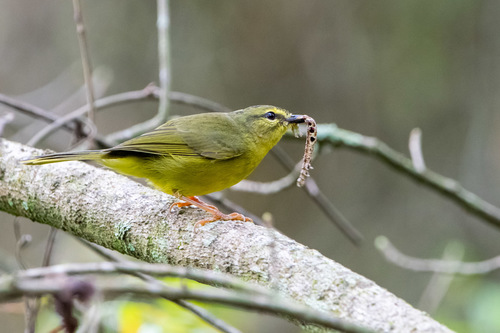
Two-banded Warbler
Myiothlypis bivittata
With its striking golden belly and bold 'racing stripes' across its crown, the Two-banded Warbler is a vibrant gem of the South American cloud forests. Watch this energetic insect-hunter dance through the undergrowth with unmatched agility.
Quick Identification
Size
Length: 13–14 cm (5.1–5.5 inches); Weight: 10–14 g (0.35–0.5 oz)
Colors
Olive-green upperparts with bright yellow underparts; head features two distinct black lateral crown stripes bordering a yellow or buff central stripe.
Key Features
- Bold black lateral crown stripes
- Bright yellow throat and belly
- Olive-green wings and back
- Dainty, pointed bill for insect-eating
- Small, active frame with frequent tail flicking
When You’ll See Them
Behavior
The Two-banded Warbler is a restless and energetic little bird, typically found flitting through the dense undergrowth of montane forests. Unlike many other warblers that stay high in the canopy, this species prefers the shadows of the forest floor and mid-story, where it constantly hops from branch to branch in search of food. They are often seen in pairs or small family groups, maintaining contact with sharp, metallic chipping calls that help them navigate the thick foliage.
While they are naturally cautious, they are not particularly shy of human presence if you remain still. They are frequently observed as part of mixed-species foraging flocks, following larger birds to capitalize on the insects they flush out of the vegetation. Their movement is distinctive—a series of quick, nervous flickers of the wings and tail as they probe mossy logs and damp leaf litter for their next meal.
EverydayEarth exclusive
Camera Tips
To capture the Two-banded Warbler on camera, placement is everything. Since this species is an understory specialist, you should position your camera low to the ground—ideally between 1 and 3 feet (30-90 cm) high. Look for natural clearings in the brush, mossy logs, or areas with thick leaf litter where they are likely to forage for insects. Angle the camera slightly upward if placing it near a favorite low perching branch to catch the vibrant yellow of their underparts and those signature crown stripes.
Water is a major draw for these warblers. In the humid montane forests they call home, a small, shallow birdbath or a natural dripping water feature can be a magnet. Set your camera near a slow-moving stream or a puddle that forms after rain. Use a fast shutter speed or a high-frame-rate video setting (at least 60fps), as these birds move with incredible speed and can easily become a blur in standard shots. A camera with a 'fast trigger' or 'burst mode' is essential, as they rarely stay in one spot for more than a second.
Lighting in dense forest environments can be a challenge. Try to place the camera in a spot that receives filtered morning light, which will highlight the olive and yellow hues without washing them out. If your camera has adjustable sensitivity, set the PIR (Passive Infrared) sensor to 'High' to ensure it triggers for such a small, fast-moving subject. Because they are strictly diurnal, ensure your camera is set to its most sensitive daytime mode; a subtle fill-flash or high-quality IR during the dim dawn hours can help clarify details in the dark forest shadows before the sun fully penetrates the canopy.
Similar Species
Species that look similar or are commonly confused with Two-banded Warbler.
Golden-crowned Warbler
The Golden-crowned Warbler has a brighter, often orange-tinged patch in the center of its crown stripes and more prominent white in the tail.
Pale-legged Warbler
Lacks the bold, contrasting black crown stripes and generally has lighter-colored legs and a more uniform head color.
Frequently Asked Questions
Record Two-banded Warbler at your habitat
Connect a camera to start building your own species record — AI identifies every visitor automatically.