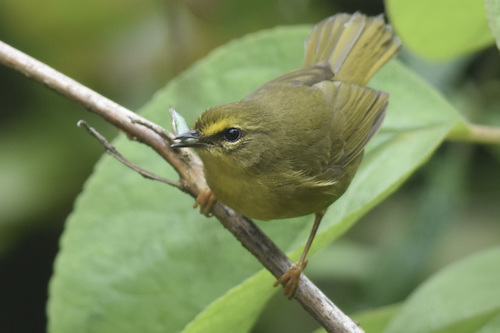
Pale-legged Warbler
Myiothlypis signata
A restless spark of yellow in the Andean mist, the Pale-legged Warbler is a master of the forest undergrowth. Identifiable by its distinctively light-colored legs, this active bird brings a sense of constant motion to any backyard it visits.
Quick Identification
Size
13.5–14 cm (5.3–5.5 inches) in length; weighs approximately 12–15 grams (0.4–0.5 oz)
Colors
Olive-green upperparts with bright yellow underparts; features a prominent yellow supercilium (eyebrow) and a dark eye-line. Distinguishable by its pale pinkish-buff or flesh-colored legs.
Key Features
- Pinkish or pale-flesh colored legs
- Long, bright yellow eyebrow stripe
- Uniformly yellow throat, breast, and belly
- Restless, active foraging behavior in low foliage
When You’ll See Them
Behavior
The Pale-legged Warbler is a high-energy inhabitant of the Andean cloud forests. It is most often observed in the lower to middle levels of the forest canopy, where it moves restlessly through the foliage. Unlike more sedentary species, this warbler is constantly on the move, flicking its wings and tail as it hops between branches to flush out small insects. It is a social bird, frequently found in pairs or joining larger, mixed-species foraging flocks that roam the forest together.
While they are primarily forest birds, they are surprisingly bold and adaptable to human-altered environments. They are common sights in gardens and small woodland patches near montane towns. While they don't seek out human interaction, they are relatively tolerant of people and can be quite curious, often pausing to inspect a well-placed camera or a new garden feature before continuing their frantic search for food.
EverydayEarth exclusive
Camera Tips
To capture the best footage of a Pale-legged Warbler, target the 'understory transit zones' in your yard. These birds rarely fly across wide-open spaces; instead, they follow corridors of dense shrubs or hedgerows. Mount your camera at a height of 3 to 5 feet, angled slightly downward toward a horizontal branch or a gap between bushes where the bird is likely to pause. Using an AI-powered trigger with a high sensitivity setting is crucial, as their rapid movements can sometimes be missed by slower sensors.
While they won't visit seed or suet feeders, water is an irresistible lure. A shallow birdbath with a solar-powered dripper or a small fountain is highly effective. The sound of moving water acts as a beacon for these warblers. Position your camera 4-5 feet away from the water source to ensure the bird fills enough of the frame for the AI to identify the species while maintaining enough distance to capture its quick arrival and departure.
Lighting in the cloud forest or montane environments can be tricky and often dim. If your camera has adjustable settings, prioritize a fast shutter speed to reduce motion blur. Because these birds are most active in the early morning, try to position the camera so it isn't facing directly into the rising sun, which can wash out the delicate yellow and olive colors of their plumage. If your camera supports it, enable 'burst' or 'photo-then-video' mode to catch both the still identification marks and their unique flicking behavior.
Finally, consider the seasonal vegetation. In the South American spring, these warblers are particularly attracted to native flowering shrubs that harbor high insect populations. If you can identify a specific shrub they frequent, move your camera to within a few feet of that bush. The Pale-legged Warbler is a creature of habit and will often follow the same foraging route through a garden at roughly the same time every morning.
Similar Species
Species that look similar or are commonly confused with Pale-legged Warbler.
Citrine Warbler
Almost identical in plumage, but the Citrine Warbler has dark legs and a slightly more defined dark crown.
Russet-crowned Warbler
Shares a similar yellow belly but is easily distinguished by its bright rufous-brown crown patch.
Two-banded Warbler
Features two distinct pale wing bars and a different facial pattern than the Pale-legged Warbler.
Frequently Asked Questions
Record Pale-legged Warbler at your habitat
Connect a camera to start building your own species record — AI identifies every visitor automatically.