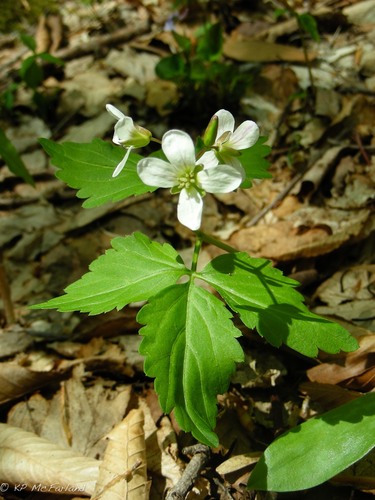
Two-leaved Toothwort
Cardamine diphylla
A delicate herald of spring, the Two-leaved Toothwort carpets the forest floor with starry white blossoms before the trees even wake. This resilient wildflower is a vital lifeline for the season's first pollinators.
Quick Identification
Size
Height ranges from 8 to 16 inches (20 to 40 cm); individual flowers are approximately 0.5 to 0.75 inches (1.3 to 1.9 cm) wide.
Colors
Four-petaled flowers are typically white to pale pink or lavender; foliage is a deep, rich green with occasional purple tinges on the stems.
Key Features
- Two nearly opposite leaves located halfway up the flowering stem
- Each leaf is divided into three distinct, coarsely toothed leaflets
- White to pinkish-purple flowers arranged in a terminal cluster (raceme)
- Continuous, fleshy underground rhizome with tooth-like protrusions
When You’ll See Them
Behavior
The Two-leaved Toothwort is a classic spring ephemeral, a group of forest plants that complete their reproductive cycle quickly in the early spring. It emerges while the forest floor is still bathed in sunlight, blooming and setting seed before the overhead deciduous canopy fully leaves out. By mid-summer, the above-ground portion of the plant often disappears entirely as it goes dormant to survive the heat.
As a member of the mustard family, it plays a vital role in the early season ecosystem. It serves as an essential nectar source for early-emerging pollinators, particularly solitary bees and beeflies. Unlike some plants that spread primarily by seed, the Two-leaved Toothwort is an effective colonizer through its horizontal underground stems (rhizomes), often forming charming, carpet-like patches across the woodland floor.
EverydayEarth exclusive
Camera Tips
Capturing the Two-leaved Toothwort requires a different approach than mobile wildlife. Since this plant only stands about a foot tall, you must position your camera at a very low 'worm’s-eye' view. Using a ground-level tripod or a specialized stake mount is essential. Aim for a 45-degree upward angle to capture both the unique leaf structure and the delicate interior of the downward-nodding flowers. If your camera has a macro or 'close focus' setting, this is the time to use it to highlight the fine details of the petals and stamens.
While the plant itself is stationary, it is a magnet for high-speed action. Set your camera to a fast trigger speed or high-frame-rate video mode to catch the West Virginia White butterfly—a rare species that depends on toothworts—as it lands to lay eggs. Early morning light provides a soft, ethereal glow that prevents the white petals from 'blowing out' or overexposing in your images. If your camera allows for time-lapse, setting it to take a photo every 30 minutes over a three-day period will create a stunning sequence of the flowers opening and following the sun's arc.
Pay close attention to the background. Because these plants grow in cluttered forest litter, use a wide aperture (if available) to blur the brown leaves behind the plant, making the vibrant green and white pop. For the best 'behavioral' shots, monitor the weather; the flowers often close during rain or at night, so time your captures for bright, still mornings when pollinator activity is at its peak. Ensure you clear away any stray dead leaves or twigs that might be blocking the lens before you leave the camera in place for the week.
Similar Species
Species that look similar or are commonly confused with Two-leaved Toothwort.
Frequently Asked Questions
Record Two-leaved Toothwort at your habitat
Connect a camera to start building your own species record — AI identifies every visitor automatically.