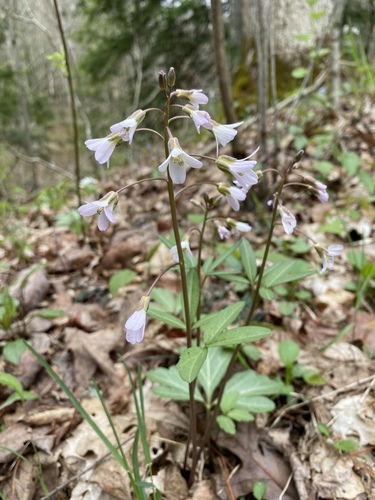
Slender toothwort
Cardamine angustata
A delicate herald of the changing seasons, the Slender Toothwort paints the forest floor in hues of white and pink. This native spring ephemeral is a vital early-season lifeline for our local pollinators.
Quick Identification
Size
6-12 inches (15-30 cm) in height; flowers are approximately 0.5-0.75 inches (1.3-1.9 cm) wide.
Colors
Flowers are white to pale pink or light purple; stems are green to burgundy; leaves are deep forest green.
Key Features
- Four petals arranged in a cross shape
- Narrow, deeply lobed stem leaves with 3 leaflets
- Blooms in early spring before the forest canopy closes
- Fleshy, jointed underground rhizomes
When You’ll See Them
Behavior
The Slender Toothwort is a quintessential spring ephemeral, a group of plants that have adapted to the unique light conditions of the deciduous forest. It completes its entire above-ground life cycle in a frantic few weeks during early spring. By emerging while the trees are still bare, it captures the maximum amount of sunlight possible, storing energy in its underground rhizome before the summer shade forces it into dormancy.
Though it appears delicate, the Slender Toothwort is quite resilient. Its flowers are highly sensitive to temperature and light; they typically open wide during sunny, warm afternoons to welcome pollinators and may droop or close during cold nights to protect their reproductive organs. This movement, known as nyctinasty, ensures the plant's survival in the unpredictable weather of early spring.
As the season progresses and the forest floor grows dark under the leafy canopy, the Slender Toothwort quickly produces seed pods and then withers away. By mid-summer, the plant has completely disappeared from the surface, leaving no trace of its existence until the following year, when it will sprout again from its persistent root system.
EverydayEarth exclusive
Camera Tips
Capturing the Slender Toothwort requires a different strategy than tracking mobile wildlife. Because this species is stationary and small, your camera setup must prioritize close-focus capabilities. Use a tripod or a specialized ground mount to position your camera just 5 to 8 inches off the forest floor. If your camera has a 'Macro' mode or a 'Close-Focus' setting, this is the time to use it. If you are using a standard trail camera, check the minimum focal distance; you may need to back up slightly to ensure the delicate four-petaled flowers aren't a blurry mess.
To document the plant's fascinating life cycle, utilize the Time-Lapse function. Set your camera to take one high-resolution photo every 15 to 30 minutes during daylight hours. This will allow you to create a video showing the flowers 'waking up' and opening as the sun hits them, and then closing back up as evening approaches. This technique also helps you catch the very moment of blooming, which can happen surprisingly fast during a warm spring day.
The real 'action' for this species involves its pollinators. To catch these visitors, use a high-sensitivity trigger setting with a short video duration (10-15 seconds). This will help you document the various native bees, beeflies, and butterflies that rely on Slender Toothwort as an early-season nectar source. Because the white petals can easily 'blow out' or appear too bright in direct sunlight, try to angle your camera so the sun provides side-lighting rather than hitting the flowers directly from behind the lens.
Keep a close eye on the weather and your local forest floor starting in late February. The window to catch this species is narrow. Once you see the first purple-tinged shoots breaking the leaf litter, get your camera in place immediately. Because they often grow in colonies, look for a cluster of buds rather than a single stem to increase your chances of capturing a spectacular floral display. Make sure to clear away any dead leaves that might obstruct the camera's view or trigger the motion sensor in the wind.
Similar Species
Species that look similar or are commonly confused with Slender toothwort.
Frequently Asked Questions
Record Slender toothwort at your habitat
Connect a camera to start building your own species record — AI identifies every visitor automatically.