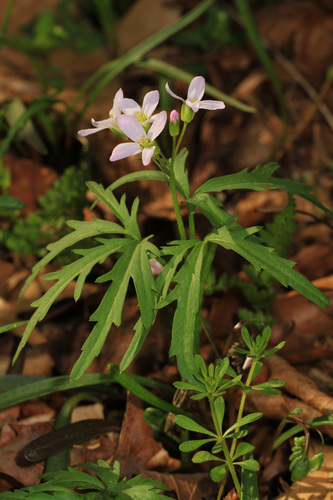
cut-leaved toothwort
Cardamine concatenata
A quintessential harbinger of spring, the Cut-leaved Toothwort blankets forest floors with delicate white blooms before the trees leaf out. Its 'toothed' roots and intricate leaves make it a favorite for woodland explorers and early-season pollinators alike.
Quick Identification
Size
Grows 20–40 cm (8–16 inches) in height with a similar spread in colonial patches.
Colors
White to pale pink or lavender four-petaled flowers; deep green foliage often with purple undersides.
Key Features
- Deeply divided leaves in a whorl of three, each with sharp tooth-like lobes
- Clusters of nodding, bell-shaped white to pinkish flowers
- Jointed, fleshy, white rhizomes that resemble teeth buried just below the surface
When You’ll See Them
Geographic range
Where Does the cut-leaved toothwort Live?
The cut-leaved toothwort is a proud native of eastern North America, where it thrives in the dappled sunlight of early spring forests. Its range stretches from the southern reaches of Quebec and Ontario in Canada, sweeping down through the eastern half of the United States to the Gulf Coast states like Florida and Louisiana, and as far west as Oklahoma and Nebraska. This hardy perennial is a staple of the Appalachian mountains and the fertile river valleys of the Midwest, making it a common sight for backyard naturalists in temperate woodland regions.
Basemap © OpenStreetMap contributors
Behavior
Cut-leaved toothwort is a true spring ephemeral, meaning it completes its entire above-ground life cycle in the brief window between the thawing of the soil and the closing of the forest canopy. It emerges early in the spring, taking advantage of the direct sunlight reaching the forest floor before the deciduous trees leaf out. Once the shade deepens in late May or June, the plant goes dormant, disappearing entirely from view until the following year.
As a colony-forming plant, it spreads slowly via its brittle, jointed rhizomes. While it doesn't 'behave' in the animal sense, it maintains a vital relationship with early-season pollinators. It is a critical host plant for the West Virginia White butterfly (Pieris virginiensis), providing nectar for adults and foliage for larvae. Humans often encounter it while foraging, as the rhizomes have a pungent, peppery taste similar to horseradish, though it is best left undisturbed in the wild to support local ecosystems.
EverydayEarth exclusive
Camera Tips
To capture the delicate beauty of cut-leaved toothwort, place your camera on a low-profile tripod or directly on the forest floor. Because these plants are small, a 'worm's eye view' creates a more immersive image than looking down from above. If your camera has a macro setting or a close-focus lens, use it to highlight the 'teeth' on the leaf margins and the subtle veins in the petals. This species is best photographed during the 'golden hours' of early morning or late afternoon when the sun filters through the bare branches of the overhanging trees.
For a unique project, set your camera to a time-lapse mode during a warm week in April. Because spring ephemerals grow and bloom rapidly, you can capture the entire process from sprout to full bloom over just a few days. Ensure your camera is well-camouflaged and protected from spring showers, as these plants thrive in moist conditions. Avoid using heavy flashes, which can wash out the delicate white and pale pink hues of the petals; natural, diffused light on a slightly overcast day is ideal.
If you are using a motion-activated trail camera, aim it at a cluster of toothwort to capture the specialized pollinators that visit. The West Virginia White butterfly and various early-season bees are frequent visitors. Set your trigger speed to the fastest possible setting and use a high frame rate for video, as these insects move quickly. Positioning the camera about 12-18 inches away from the blooms will give you the best chance of seeing the interaction between the plant and its wild visitors.
Similar Species
Species that look similar or are commonly confused with cut-leaved toothwort.
Frequently Asked Questions
Record cut-leaved toothwort at your habitat
Connect a camera to start building your own species record — AI identifies every visitor automatically.