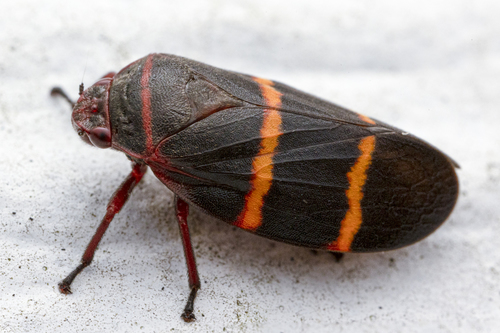
Two-lined Spittlebug
Prosapia bicincta
A striking master of disguise and jumping, the Two-lined Spittlebug brings a splash of racing-stripe color to Eastern US gardens. Famous for the bubbly 'spittle' of its youth, the adult is a high-speed acrobat of the grass.
Quick Identification
Size
8–10 mm (0.31–0.39 inches) in length
Colors
Jet-black body and wings with two distinct horizontal orange or bright red bands crossing the forewings
Key Features
- Two parallel orange or red horizontal wing bands
- Jet-black elongated oval body
- Large, frog-like eyes on a wide head
- Size between 8 and 10 mm
When You’ll See Them
Geographic range
Where Does the Two-lined Spittlebug Live?
Native to the North American continent, the two-lined spittlebug is a common sight across the eastern half of the United States. Its range extends from the Atlantic coast westward to the Great Plains, reaching into Kansas and Oklahoma. It is particularly prevalent in the humid environments of the Southeast and Gulf Coast, and populations are also documented in parts of Mexico and the Caribbean where suitable host plants thrive.
Basemap © OpenStreetMap contributors
Behavior
Two-lined spittlebugs are fascinating 'froghoppers' known for their impressive jumping ability and the peculiar bubbly nests they create as juveniles. The adults are active fliers and jumpers, using their powerful hind legs to launch themselves into the air when threatened. They are primarily solitary but can be found in high concentrations where their favorite host plants are abundant. While they are often seen resting on the upper surfaces of leaves, they spend much of their time feeding on plant fluids.
The name 'spittlebug' comes from the nymph stage, which produces a frothy, spit-like mass of bubbles. This secretion is actually a mixture of air and excreted xylem fluid that protects the vulnerable nymphs from predators and prevents them from drying out. Humans usually encounter adults during the summer months when they emerge from the grass to feed on shrubs and ornamental plants.
EverydayEarth exclusive
Camera Tips
Capturing the two-lined spittlebug requires a focus on macro photography. Because of their small size, place your AI camera or macro setup very close to known host plants—specifically holly bushes (Ilex) or tall, lush grasses. These insects are most active during the warmest parts of the day, so ensure your camera is positioned to catch the bright, direct sunlight where they like to bask on the tops of leaves.
To find the best placement, look for the 'spittle' masses near the base of your lawn or in thick weeds; these indicate that adults will soon be emerging in that immediate area. Mount your camera at a height of about 1 to 3 feet off the ground, angled slightly upward to capture them as they crawl toward the top of plant stems. Since they are prone to leaping when they detect movement, a motion-activated trigger with a very fast shutter speed is essential to freeze their motion before they jump out of frame.
If you are using a backyard station, avoid using heavy pesticides, as these bugs are sensitive to chemicals. Instead, keep a patch of centipede grass or Bermuda grass well-watered. In the Southeast US, there are usually two major population peaks—one in early summer and another in late summer—so plan your camera deployment for June and August for the highest chance of capturing a high-density 'event.'
Similar Species
Species that look similar or are commonly confused with Two-lined Spittlebug.
Frequently Asked Questions
Record Two-lined Spittlebug at your habitat
Connect a camera to start building your own species record — AI identifies every visitor automatically.