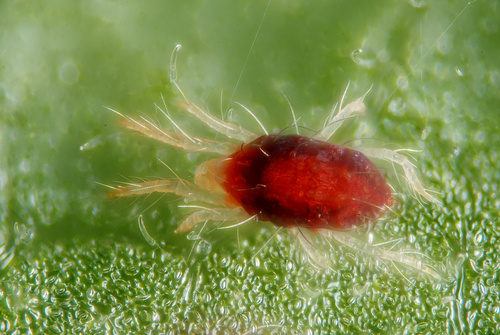
Twospotted Spider Mite
Tetranychus urticae
The Twospotted Spider Mite is a master weaver that builds an entire world on the underside of a single leaf. Nearly invisible to the naked eye, these tiny arachnids create intricate silk cities and thrive in the peak heat of summer.
Quick Identification
Size
0.3 to 0.5 mm (1/80 to 1/50 inch) in length; roughly the size of a grain of salt.
Colors
Translucent pale green to yellow-orange; two large, dark digestive spots on the sides; overwintering females turn bright reddish-orange.
Key Features
- Two prominent dark spots on the side of the body
- Fine, silken webbing on the undersides of leaves
- Tiny, oval-shaped body with eight legs in adults
- Presence of yellow 'stippling' or white dots on host plant leaves
When You’ll See Them
Behavior
The Twospotted Spider Mite is a fascinating engineer of the microscopic world. Unlike true spiders, these mites use their silk not to catch prey, but to create a protective micro-environment. They live in bustling colonies on the undersides of leaves, where they spin complex silken layers that shield them from wind, rain, and larger predators like ladybugs. This webbing also helps maintain a humid microclimate, which is essential for their survival in the hot, dry conditions they prefer.
These arachnids are highly social in their own way, often congregating in large numbers when food is plentiful. They communicate through chemical signals and vibrations within their silk networks. When a plant becomes overcrowded or begins to wither, these mites exhibit a remarkable behavior called 'ballooning'—they climb to the highest point of the plant, spin a long silk thread, and allow the wind to carry them to a new host plant. This allows them to colonize entire gardens in a surprisingly short amount of time.
EverydayEarth exclusive
Camera Tips
Capturing the Twospotted Spider Mite requires a departure from standard trail camera techniques due to their microscopic size. To see them with your EverydayEarth setup, you will need a dedicated macro lens attachment or a high-magnification digital microscope camera. Focus your lens specifically on the undersides of leaves that show 'stippling'—a pattern of tiny yellow or white dots on the upper surface that indicates a colony is feeding below. A stable mounting system is non-negotiable; even a slight breeze or a minor camera shake will result in a blurry image at this magnification level.
Lighting is the most critical factor for a clear shot. Avoid harsh, direct midday sun which can blow out the details of their translucent bodies. Instead, use a white reflector or a diffused LED light source to illuminate the underside of the leaf from a slight angle. This side-lighting will make the silken webs 'glow' and provide enough contrast to see the two dark spots inside the mite's body. If your camera has a 'focus peaking' feature, use it to ensure the tiny hairs (setae) on the mite's back are in sharp focus.
To capture their life cycle, set your camera to a time-lapse mode with an interval of one frame every 30 minutes. This will allow you to see the colony expand, the eggs hatch, and the intricate silken canopy grow over several days. If you are looking for more 'action,' record at 60 frames per second on a hot afternoon; you will be surprised at how fast these tiny creatures can move across a leaf surface when the temperature exceeds 80°F (27°C).
For the most dramatic footage, look for 'ballooning' behavior. Position your camera at the very tip of a leaf or a stem on a slightly breezy day. You might catch the moment a mite stands on its rear legs and releases a silk strand to take flight. Using a dark, non-reflective background—like a piece of black cardstock held a few inches behind the leaf—will make the translucent mites and their silk stand out vividly against the green of the plant.
Similar Species
Species that look similar or are commonly confused with Twospotted Spider Mite.
Frequently Asked Questions
Record Twospotted Spider Mite at your habitat
Connect a camera to start building your own species record — AI identifies every visitor automatically.