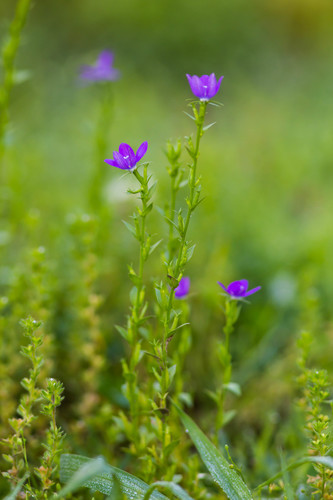
Venus's looking-glass
Triodanis biflora
A fleeting violet treasure of the late spring, Venus's looking-glass brings a touch of celestial color to sun-drenched meadows. Known for its mirror-like seeds and unique dual-blooming habit, it is a fascinating subject for any backyard botanist.
Quick Identification
Size
Stems reach 10-60 cm (4-24 inches) in height; flowers are 10-15 mm (0.4-0.6 inches) wide.
Colors
Deep violet to lavender-purple petals with a pale white or yellowish throat; stems and leaves are a vibrant medium green.
Key Features
- Five-lobed, star-shaped purple flowers
- Alternate, sessile leaves that are longer than they are wide
- Upright, slender stems that may be simple or branched at the base
- Distinctive glossy, reddish-brown seeds that resemble tiny mirrors
When You’ll See Them
Behavior
Venus's looking-glass is a resilient annual wildflower that specializes in colonizing open, sunny spaces. It utilizes a fascinating dual-flowering strategy to ensure its survival: the lower flowers are 'cleistogamous,' meaning they never open and self-pollinate in the bud, while the upper flowers are 'chasmogamous,' opening wide to invite cross-pollination from small bees and flies. This 'insurance policy' allows the plant to produce seeds even if pollinator activity is low.
In a backyard ecosystem, this plant acts as a seasonal pioneer. It often emerges in areas where the soil has been recently turned or where grass is thin, blooming quickly before the heat of mid-summer sets in. It doesn't spread aggressively like some weeds, instead forming charming, temporary clusters that provide a critical early-season nectar source for native insects.
EverydayEarth exclusive
Camera Tips
To capture the delicate beauty of Venus's looking-glass, you must rethink your camera height. Since these plants are relatively low-growing, mount your camera on a ground-level stake or a mini-tripod only 6 to 12 inches off the turf. Angle the lens slightly upward to capture the 'bell' of the flower against the sky or a softer background, which helps the purple petals pop against the green foliage.
Because plants are stationary, standard motion-trigger settings may not activate unless a pollinator visits. To document the blooming process, switch your camera to 'Time-Lapse' mode. Set the interval to one photo every 15 minutes during daylight hours. This will allow you to see the flowers open as the sun hits them and close as the evening approaches, creating a beautiful narrative of the plant’s daily cycle.
If you are using an AI-powered camera to identify visiting insects, place the camera within the 'Macro' or close-focus range (usually 1-2 feet depending on the model). Small sweat bees and beeflies are the primary visitors. Position the camera so the sun is behind you or to the side; direct midday sun from above can wash out the deep violet hues of the petals. Early morning 'Golden Hour' provides the most flattering, warm light that highlights the fine hairs on the plant's stem.
Check your local weather forecast and aim for a calm day. Because the stems of Triodanis biflora are so slender, they will sway significantly in even a light breeze, which can result in motion blur in low-light conditions. Increasing your shutter speed or ensuring the area is well-lit will help maintain the crispness of the five-lobed petal structure and the serrated edges of the leaves.
Similar Species
Species that look similar or are commonly confused with Venus's looking-glass.
Frequently Asked Questions
Record Venus's looking-glass at your habitat
Connect a camera to start building your own species record — AI identifies every visitor automatically.