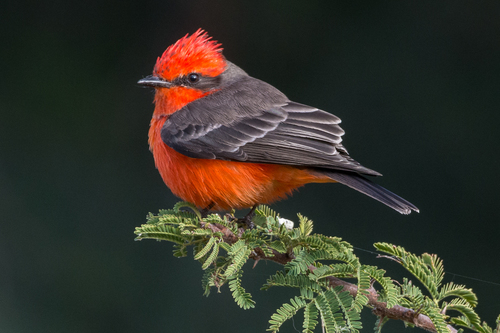
Vermilion Flycatcher
Pyrocephalus rubinus
A flash of brilliant scarlet against the sky, the Vermilion Flycatcher is a living gem of the Americas. This small but bold aerial acrobat is a backyard favorite, known for its stunning color and impressive mid-air hunting displays.
Quick Identification
Size
Length: 4.7–5.5 in (12–14 cm); Wingspan: 9.5–10 in (24–25 cm); Weight: 0.4–0.5 oz (11–14 g)
Colors
Males feature a brilliant scarlet-red crown and underparts with a dark chocolate-brown mask, back, wings, and tail. Females are brownish-gray above with a white, finely streaked breast and a soft peach or salmon-pink wash on the belly.
Key Features
- Brilliant scarlet crown and underparts on males
- Dark brown mask extending from the bill through the eye
- Frequent tail-wagging behavior while perched
- Small, straight black bill with a slight hook at the tip
When You’ll See Them
Behavior
The Vermilion Flycatcher is a classic 'sit-and-wait' predator, a master of the aerial ambush. You will typically find them perched prominently on a low branch, fence wire, or even a garden stake, scanning the air for movement. When an insect is spotted, the bird launches into a graceful, acrobatic loop to snatch its prey mid-air, often returning to the exact same perch to enjoy its meal. This repetitive 'sallying' behavior makes them one of the most rewarding birds to observe once you identify their favorite hunting station.
Socially, these birds are fiercely territorial during the breeding season. Males perform spectacular 'butterfly' display flights, where they flutter high into the air with ruffled feathers and a stuttering song to impress mates and warn off rivals. Despite their bold color, they are relatively tolerant of human activity and are frequently seen in suburban parks, golf courses, and backyards where water and open spaces are available.
EverydayEarth exclusive
Camera Tips
To capture the stunning red of a male Vermilion Flycatcher, placement is everything. These birds are creatures of habit; they prefer perching on exposed, slender branches or fence lines about 3 to 10 feet off the ground. Position your AI-powered camera facing a known 'sallying' perch—a spot where you've seen them return repeatedly. Angle the camera slightly upward to capture the bird against the sky or a distant, blurred background, which helps that vibrant red plumage pop. Avoid pointing the lens directly into the sun; instead, keep the sun at your back to fully illuminate their brilliant colors.
Since they are strict insectivores, traditional birdseed won't work as a lure. Instead, focus on water features or 'natural lures.' A birdbath with a solar dripper or a small fountain is an irresistible draw for Vermilion Flycatchers, especially in arid environments. Setting your camera to a 'high-speed' video mode or a fast shutter speed is crucial, as their movements are lightning-fast. If your camera supports it, use a 0.1 to 0.2-second trigger speed to ensure you catch the moment they land rather than just a blur of feathers or an empty branch.
During the spring breeding season, males are much more active and vocal. This is the best time to set your camera to video mode to capture their fluttering display flights and unique song. If you have a backyard with a lawn, keep a corner slightly 'wild' or use a low-profile perch like a decorative garden stake in an open area. They love these vantage points for spotting ground-dwelling insects. Finally, check your camera's exposure settings; the intense red of the male can sometimes 'blow out' and lose detail in direct midday sun, so the golden hours of early morning or late afternoon provide the best color saturation.
Similar Species
Species that look similar or are commonly confused with Vermilion Flycatcher.
Scarlet Tanager
Larger with jet-black wings and tail; lacks the dark eye mask and prefers high forest canopies.
Say's Phoebe
Often confused with the female flycatcher, but is larger, lacks breast streaking, and has a more uniform cinnamon belly.
Summer Tanager
The Summer Tanager is entirely rose-red without the dark brown wings, tail, or eye mask of the Vermilion Flycatcher.
Frequently Asked Questions
Record Vermilion Flycatcher at your habitat
Connect a camera to start building your own species record — AI identifies every visitor automatically.